A house does more than keep indoor air out of the weather. Its roof, walls, windows, doors, and foundation are constantly exchanging thermal energy with the surrounding environment.
On a hot summer afternoon, heat may move inward through the roof and windows. During a cold winter night, the direction reverses as indoor heat moves toward colder exterior surfaces. Air can also leak through small gaps, carrying heat with it. At the same time, warm surfaces exchange energy through radiation even when the surfaces are not touching.
These processes fall into three basic categories: conduction, convection, and radiation. They are easy to define separately, but inside a real building envelope they rarely operate alone. Understanding how they interact makes it easier to understand why insulation, air sealing, window design, and other building measures work—and why fixing one problem does not always solve the whole thermal picture.
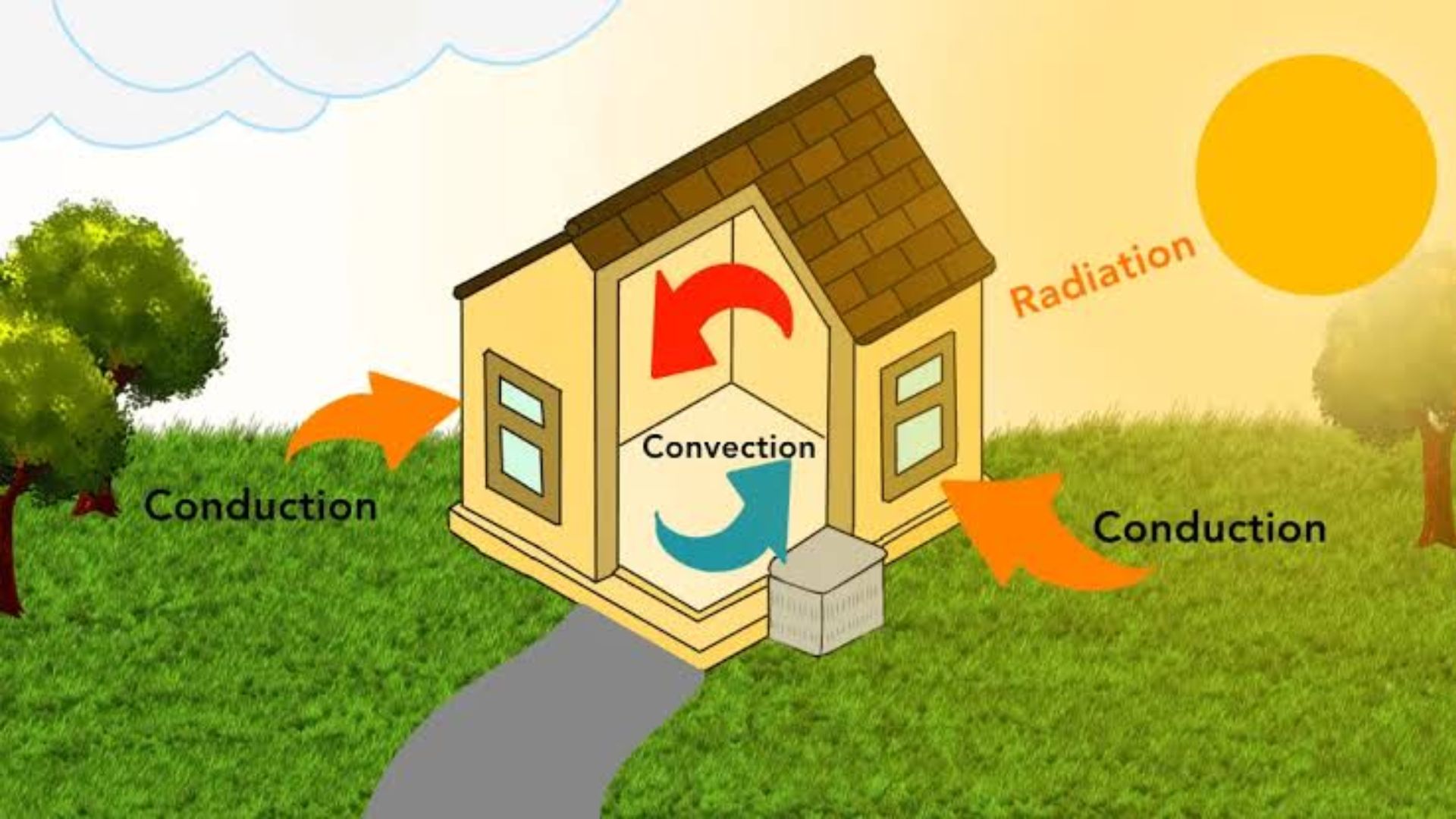
Conduction is the transfer of thermal energy through a material as energy moves from warmer areas toward cooler ones. In solids, that transfer occurs through interactions between particles within the material.
A residential building contains many potential conductive paths. Wood studs, concrete foundation walls, glass, metal fasteners, and other structural components can all conduct heat. The amount of heat transferred depends on factors such as the material's thermal conductivity, thickness, surface area, and the temperature difference across the assembly.
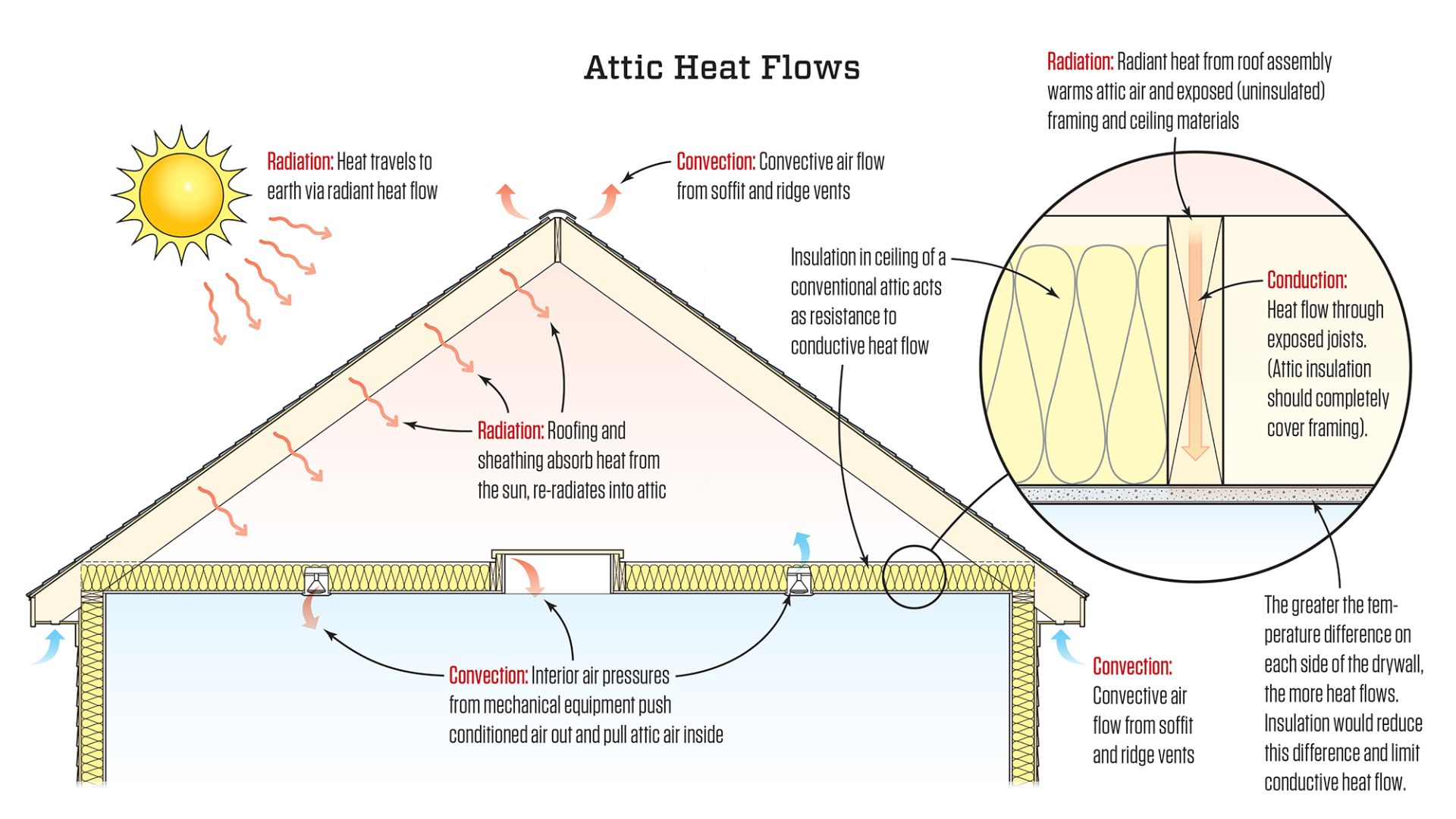
Insulation works largely by reducing this conductive heat flow. Materials such as fiberglass, mineral wool, rigid foam, and other insulation products have relatively low thermal conductivity compared with common structural materials. Their structure often includes small pockets of air or other gases, which helps limit heat transfer.
The effectiveness of insulation is commonly described using R-value in the U.S. building industry. In general, a higher R-value indicates greater resistance to conductive heat flow under the conditions used to determine that value.
The insulation layer is not the only part of a wall assembly that affects heat flow.
A thermal bridge occurs when a relatively conductive material creates a path through or around insulation. Wood framing, metal framing, structural members, fasteners, and other components can create these paths. Because the framing and insulation do not have identical thermal properties, the overall wall assembly can perform differently from what might be expected from the cavity insulation alone.
Steel framing presents a particularly strong example because steel conducts heat far more readily than most insulation materials. Without appropriate thermal breaks or continuous insulation, heat can move through framing members and reduce the effective thermal performance of the assembly.
This is one reason building designers often consider the performance of the entire wall system rather than looking only at the insulation installed between studs.
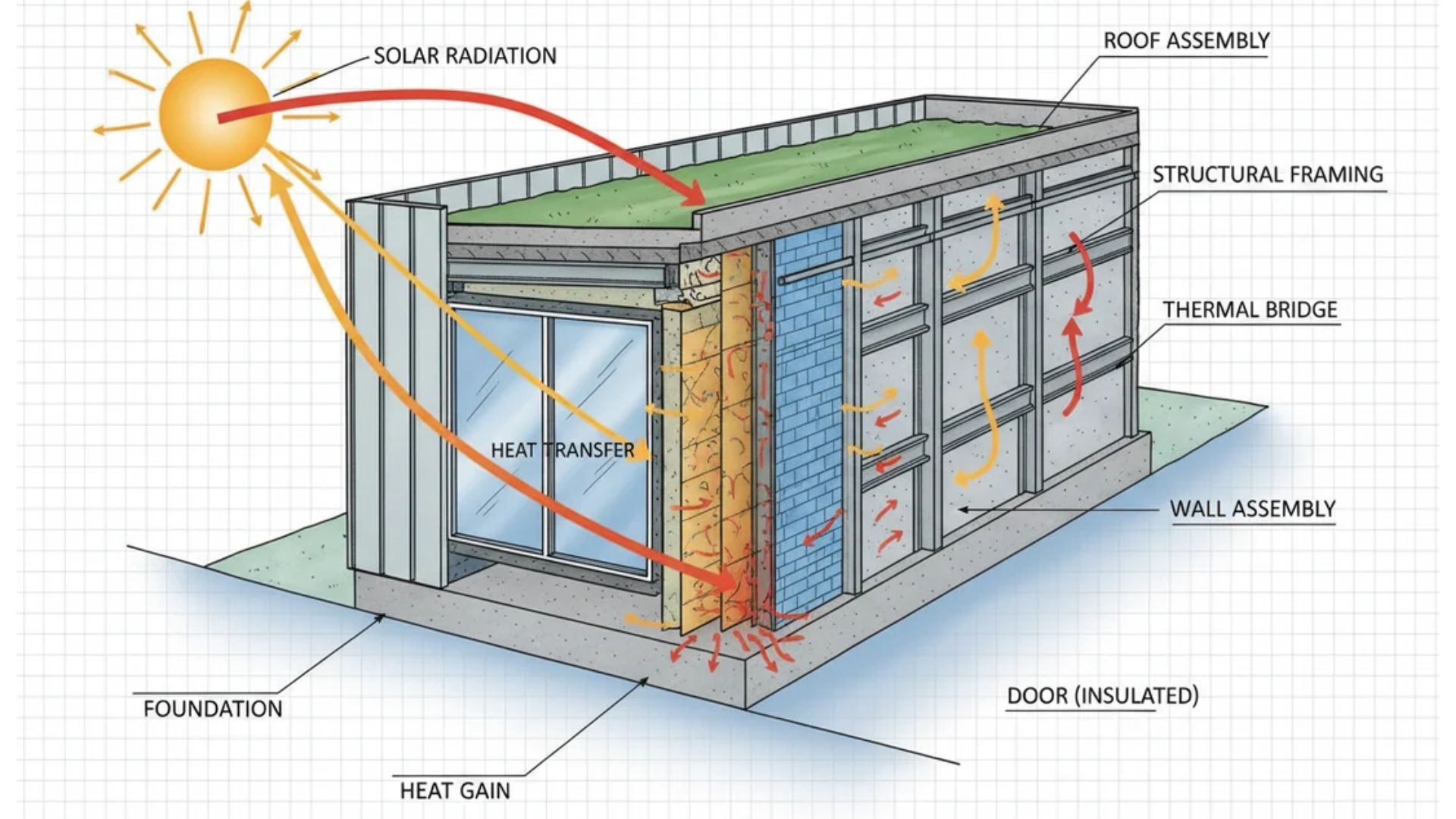
Convection involves the movement of a fluid, including air. In buildings, convection can occur when air moves through open spaces, leaks through the envelope, or circulates within enclosed cavities.
Temperature differences can create buoyancy-driven air movement. Warmer air is generally less dense than cooler air, so it tends to rise while cooler air tends to sink. Wind pressure and mechanical systems can also drive air movement through a building.
This makes convection different from conduction. Conduction transfers energy through materials; convection involves the movement of air or another fluid that carries thermal energy with it.
One of the most important forms of convective heat transfer in buildings is uncontrolled air leakage.
Small openings around windows and doors, plumbing penetrations, electrical outlets, attic access points, and other joints can provide pathways for outdoor air to enter and conditioned indoor air to escape. The resulting energy impact depends heavily on the size and location of the leaks, weather conditions, and the building's overall airtightness.
In cold weather, the stack effect can make this movement more noticeable. Warm indoor air tends to rise, creating pressure differences that encourage air to leave through openings near the upper part of a building. Replacement air can then enter through lower openings.
The size of this effect varies from one building to another. Building height, temperature difference, wind conditions, and airtightness all matter.
That is why air sealing is an important part of envelope performance. Adding insulation does not automatically eliminate heat loss caused by uncontrolled air movement.
Convection can also occur inside enclosed spaces within the building assembly.
For example, a relatively large air-filled cavity can develop circulation patterns when one side becomes warmer than the other. Air near the warm surface rises, while cooler air moves downward. If the cavity is large enough and the conditions are suitable, this circulation can contribute to heat transfer across the assembly.
Insulation can reduce this movement by dividing or restricting air spaces, while well-designed air barriers help control unwanted air movement through the building envelope.
Windows provide another example. In a sealed double- or triple-glazed unit, the space between panes is designed to limit heat transfer. The gap may contain air or an insulating gas, and the size of the gap and the properties of the glazing system influence its thermal performance.
Radiation works differently from conduction and convection. It transfers energy through electromagnetic waves and does not require direct physical contact between the surfaces exchanging energy.
Any surface above absolute zero emits thermal radiation. A warmer surface generally emits more thermal radiation than a cooler one, and surfaces can exchange radiant energy whenever they have a line of sight to one another.
Solar radiation is an especially important source of heat for buildings. Sunlight includes visible and infrared energy, along with other wavelengths. When solar radiation reaches a roof, wall, or window, part of that energy can be reflected while some is absorbed and converted into heat.
The effect is particularly noticeable at windows because sunlight can pass through glazing and warm interior floors, furniture, and other surfaces.
Windows are therefore an important part of a building's thermal balance.
Clear glass can transmit a significant amount of solar radiation. Once that energy enters the building and is absorbed by interior surfaces, those surfaces become warmer and release energy back into the room, including through longer-wavelength thermal radiation.
Modern high-performance windows can use Low-E coatings to alter this exchange. Low-emissivity coatings are designed to reduce the amount of thermal radiation emitted by the glass surface. Depending on the glazing design and coating location, they can help reduce heat loss during heating conditions and manage solar heat gain during cooling conditions.
Window performance also depends on factors such as glazing type, frame construction, orientation, shading, and climate. A Low-E coating is one component of the system rather than a universal solution for every window problem.
Radiant barriers take advantage of a different principle.
A radiant barrier typically uses a low-emissivity, highly reflective surface positioned next to an air space. In a hot, sunny climate, a properly installed radiant barrier can reduce radiant heat transfer from a hot roof assembly toward the attic interior.
Its effectiveness depends heavily on installation details. The reflective surface needs an appropriate air space, and the overall result depends on the roof construction, climate, insulation, ventilation, and other characteristics of the building.
Radiant barriers should therefore be viewed as one part of an attic assembly rather than a replacement for insulation. Their benefits can be more relevant in some hot-climate applications than in others.
Real buildings do not conveniently separate heat transfer into three independent categories.
Consider a poorly insulated wall during winter. Heat from the conditioned room reaches the interior wall surface and can be transferred through radiation to nearby surfaces. From there, energy can move through the wall materials by conduction. If air leaks exist around electrical penetrations or other openings, moving air can carry additional heat through the assembly.
The same wall may therefore experience conduction, convection, and radiation at different locations and at the same time.
This is why improving one component does not necessarily solve every thermal problem. A wall with substantial insulation can still perform poorly if the air barrier is incomplete. A well-sealed wall can still lose considerable heat if its insulation is inadequate. Windows can introduce solar heat even when the surrounding wall has excellent insulation.
Building-envelope design works best when these mechanisms are considered together.
A useful way to think about envelope performance is to ask what is actually moving the heat.
If heat is primarily moving through a material, conduction is the main mechanism to examine. Insulation levels, material conductivity, thickness, thermal bridges, and the continuity of the thermal layer become important.
If air is moving through or within the assembly, convection deserves attention. Air leakage, pressure differences, stack effect, wind, and the continuity of the air barrier become relevant.
If surfaces are exchanging energy across an air space, radiation becomes important. Window glazing, surface emissivity, solar exposure, shading, and radiant barriers may all affect the result.
The mechanisms can overlap, but this framework helps identify where a particular improvement is likely to have the greatest effect.
Thermal performance is often discussed in terms of individual products: a particular insulation, window, coating, or roofing material.
In practice, the building assembly matters just as much.
A wall can contain high-R-value insulation and still have weak points around framing, penetrations, joints, and windows. A high-performance window can still be surrounded by poorly sealed interfaces. An attic can contain substantial insulation while losing performance because of gaps in the air barrier.
The details connecting different components often determine whether the intended thermal performance is actually achieved.
That is why building-envelope design considers continuity. The insulation layer should be thought of as a connected system, the air barrier should be continuous where the design requires it, and thermal bridges should be identified rather than treated as isolated details.
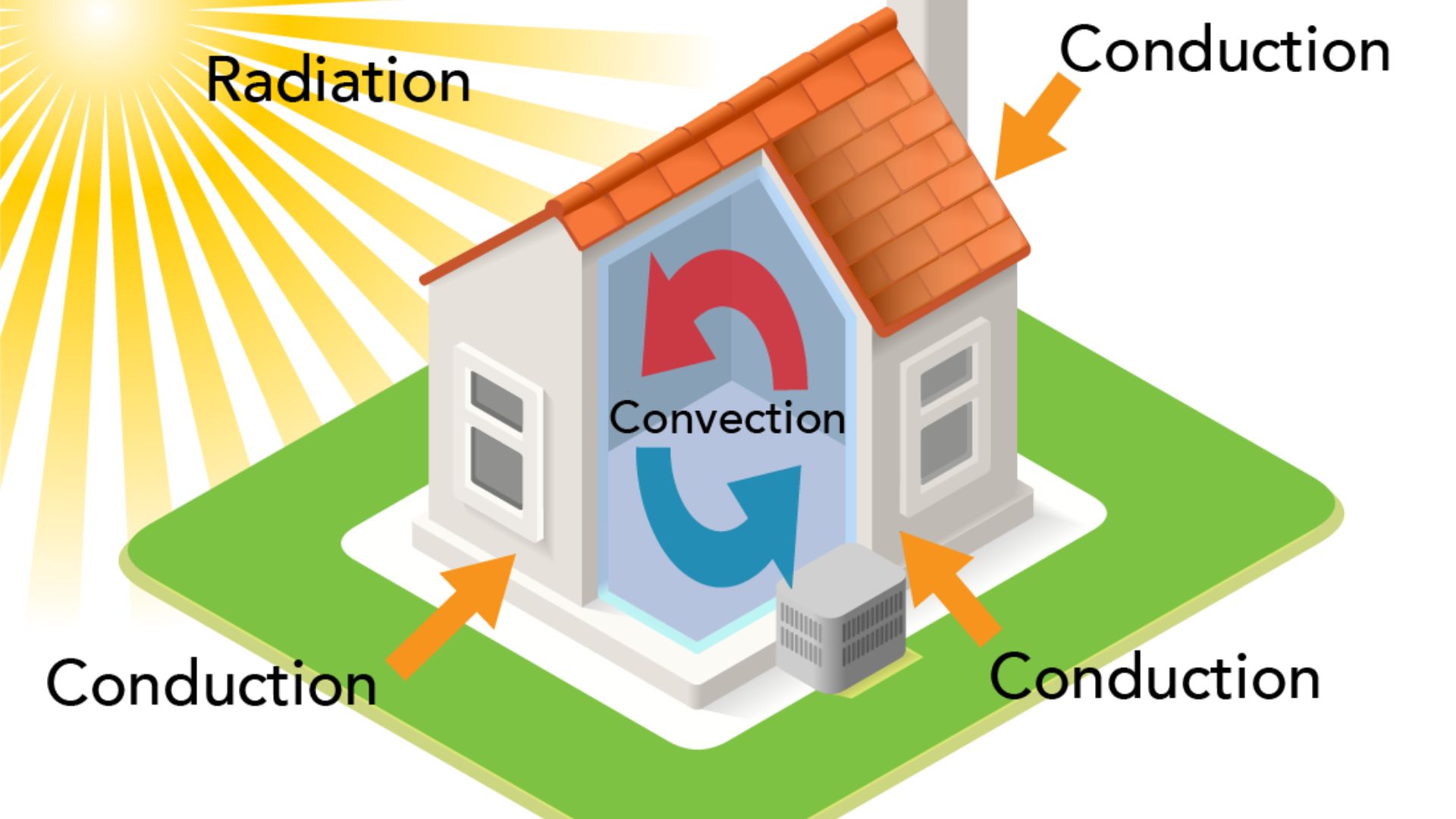
Conduction, convection, and radiation are different physical processes, but a residential building has to deal with all three.
Insulation primarily addresses conductive heat flow. Air barriers and careful air sealing help control unwanted air movement and the associated convective heat transfer. Window design, surface properties, shading, and radiant barriers can influence radiant heat exchange.
None of these measures operates in a vacuum.
A comfortable, energy-efficient home depends on how the entire envelope works as a system. Understanding the three basic heat-transfer mechanisms provides a useful starting point for evaluating that system, spotting weak points, and deciding which improvements deserve attention first.
