When evaluating the electrical performance of a residential air conditioner or heat pump, a simple wattage rating tells only part of the story. Electrical power describes how quickly equipment consumes electricity, but it does not by itself show how much useful heating or cooling that electricity produces. A 3,000-watt device and a 3,000-watt heat pump can therefore have very different effects on a home's energy demand because the useful thermal output associated with that electrical input can differ substantially.
This distinction is especially important for heat-transfer equipment. Unlike an electric resistance heater, which converts electrical energy directly into heat, a heat pump uses electricity to move thermal energy from one location to another. As a result, its useful heating or cooling output can exceed the electrical energy supplied to the equipment. COP, EER, SEER, SEER2, HSPF, and HSPF2 were developed to describe different aspects of that performance under defined operating or seasonal conditions. They are related, but they are not interchangeable numbers, and each answers a somewhat different question about equipment efficiency.
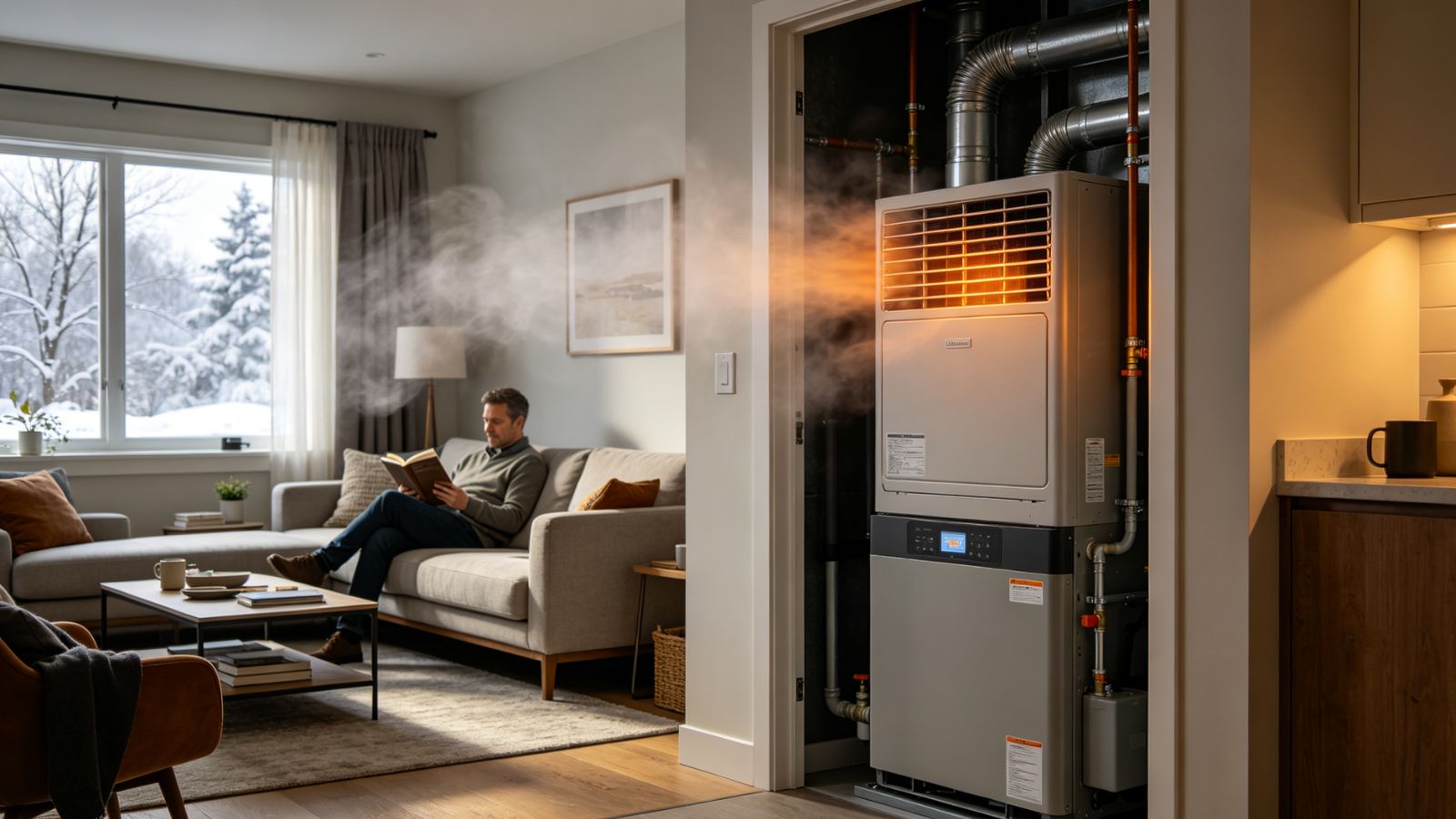
The most basic electrical measurement is power input, usually expressed in watts or kilowatts. It tells us the rate at which equipment is consuming electricity at a particular moment, which is important for understanding circuit loading and household demand. What it does not tell us is how much heating or cooling the equipment provides for that electrical input. Two systems can draw similar electrical power while producing different amounts of useful thermal output, particularly when their operating conditions, controls, or heat-transfer characteristics differ.
Heat pumps illustrate the distinction particularly clearly. In heating mode, a heat pump extracts thermal energy from outdoor air and transfers it indoors. Electricity powers the compressor, fans, controls, and other components involved in that process. The electrical energy is therefore an input to a heat-transfer process rather than the sole source of the heat delivered indoors. Under suitable conditions, the amount of heat moved indoors can be several times greater than the electrical energy consumed during the same period.
This is why efficiency ratings for heat pumps and air conditioners cannot be reduced to a single measurement of watts. A useful evaluation needs to consider both how much electricity the equipment consumes and how much useful thermal output it provides. The appropriate metric depends on whether the question concerns instantaneous thermodynamic performance, steady-state cooling performance, seasonal cooling efficiency, or seasonal heating performance.
The Coefficient of Performance, or COP, is one of the most direct ways to express the relationship between useful thermal output and electrical input. In heating mode, COP can be expressed as the rate of heat delivered to the conditioned space divided by the electrical power consumed to provide that heat. A system delivering 3,000 watts of useful heat while consuming 1,000 watts of electrical power would have a COP of 3.0 under those particular operating conditions.
That does not mean the heat pump is creating three times as much energy as it consumes. The distinction is important. The equipment is using electricity to move thermal energy from one place to another, so the thermal output includes energy transferred from the surrounding environment. Electric resistance heating behaves differently: essentially all of its electrical input is converted into heat at the point of use, giving it a COP close to 1 under the corresponding definition.
COP is particularly useful because it makes the effect of operating conditions visible. A heat pump does not have one universal COP that applies throughout an entire winter. For an air-source heat pump, the amount of work required to move heat generally increases as the outdoor temperature becomes colder relative to the indoor temperature. Equipment capacity and efficiency can therefore change substantially with outdoor conditions, while defrost operation, fan power, auxiliary resistance heating, and compressor modulation can further affect actual electrical performance.
This is why a single COP value should not be interpreted as an annual electricity-use prediction. A laboratory or rating condition represents a defined operating point, whereas a home experiences changing temperatures, changing heating and cooling loads, cycling, part-load operation, and different control conditions. COP is therefore best understood as a way to describe performance under specified conditions rather than as a substitute for a seasonal efficiency rating.
The Energy Efficiency Ratio, or EER, applies the same general idea to cooling but expresses the result using British thermal units per hour of cooling capacity divided by electrical input in watts. Because it is based on a defined steady-state test condition, EER provides a standardized way to compare cooling performance under a particular set of laboratory conditions rather than across an entire year's weather.
This distinction gives EER a useful role in understanding equipment performance at a specific operating point. A higher EER indicates that a system produces more cooling output for each watt of electrical input under the conditions used for the rating. It can therefore be helpful when comparing equipment performance under similar test conditions, particularly when evaluating how a cooling system performs under relatively demanding conditions.
EER should not, however, be treated as a direct prediction of a home's seasonal electricity consumption. Residential cooling systems do not operate at one constant outdoor temperature or one constant load. Outdoor conditions change throughout the day, the building's cooling requirement varies, and many systems operate at part load for significant portions of the season. Variable-capacity equipment can also alter compressor speed rather than simply switching between full output and complete shutdown.
This is where seasonal metrics become more useful. Instead of asking only how efficiently a system performs at one standardized operating condition, seasonal measurements attempt to represent performance across a broader set of conditions. The result is a different type of information: not a replacement for EER, but a complementary measure that is more relevant to seasonal cooling performance.

The Seasonal Energy Efficiency Ratio, or SEER, was designed to characterize cooling efficiency over a representative cooling season rather than at a single steady-state condition. In broad terms, it relates total cooling output over the defined seasonal test period to the electrical energy required to produce that output. Because the test considers varying operating conditions, SEER provides a different perspective from a single-point EER measurement.
SEER2 represents the updated rating methodology introduced with revised federal test procedures. The important point is that the “2” does not simply mean that a manufacturer has increased the old SEER number. DOE explains that SEER2, EER2, and HSPF2 were introduced to represent ratings determined under the updated test procedure, so the newer values should not be treated as directly interchangeable with the older ratings.
The distinction matters when comparing older equipment with newer products. A homeowner might encounter an older system labeled with SEER and a newer system labeled with SEER2, but the numerical values belong to different rating methodologies. A comparison therefore needs to account for the applicable test procedure rather than assuming that a particular numerical difference represents the same physical efficiency improvement in every case.
Seasonal ratings also should not be interpreted as promises about an individual home's electricity use. DOE's efficiency calculations use standardized assumptions about equipment capacity, operating hours, climate conditions, and test procedures. Actual consumption depends on factors such as local weather, building envelope performance, equipment sizing, duct losses, thermostat settings, maintenance, and how long the system operates. DOE's own efficiency examples therefore use regional assumptions when estimating annual energy use rather than treating a rating as a universal household consumption forecast.
Heating performance requires a corresponding seasonal metric. The Heating Seasonal Performance Factor, or HSPF, describes the relationship between heat supplied during a defined heating season and the electrical energy consumed during that season. HSPF2 is the updated version associated with the revised test methodology. ENERGY STAR describes HSPF2 in Btu per watt-hour and defines it using the total space-heating requirement represented for the applicable test region divided by the electrical energy consumed by the heat-pump system during the heating season.
The important difference between HSPF2 and a single COP measurement is the time scale. COP can describe performance at a particular operating condition, while HSPF2 represents performance across a defined seasonal test framework. That framework accounts for changing outdoor conditions and the operation of the equipment across different temperature conditions. DOE's testing documentation describes seasonal calculations using temperature bins and corresponding fractional hours, which is fundamentally different from evaluating a system at only one outdoor temperature.
HSPF2 can therefore provide useful information when comparing heat-pump heating performance, but it should not be interpreted as a guarantee of a particular household's heating cost. A home's actual electricity consumption depends on the local climate, building heat loss, thermostat settings, equipment sizing, duct performance, auxiliary heating, and other operating conditions. Electricity prices also vary by utility and rate structure, so a performance rating and a monetary cost estimate answer different questions.
That distinction becomes particularly important when comparing heat pumps with other heating systems. HSPF2 provides a standardized measure of heat-pump seasonal performance; it does not by itself establish which heating technology will have the lowest operating cost in every home. A meaningful cost comparison must combine equipment performance with local energy prices, expected operating conditions, and the characteristics of the building being heated.
Because these metrics all describe efficiency, it is tempting to rank them as though they were different versions of the same number. They are not. COP is a thermodynamic performance ratio generally expressed as useful heat transfer divided by input power. EER describes cooling output relative to electrical input under specified steady-state conditions. SEER2 represents seasonal cooling efficiency under its prescribed test methodology, while HSPF2 represents seasonal heating performance for air-source heat pumps under its own defined framework.
Their units and test procedures also differ. COP is dimensionless because both numerator and denominator represent power or energy in equivalent units. EER, SEER2, and HSPF2 are commonly expressed in Btu per watt-hour. The fact that some of these metrics can be converted mathematically does not make their ratings interchangeable, because the conditions and calculation methods behind the numbers are different.
A useful way to interpret them is to ask what question each metric is designed to answer. COP asks how effectively the system is moving heat under a particular operating condition. EER asks how efficiently cooling is produced under a defined steady-state condition. SEER2 asks how cooling performance is represented across a standardized seasonal test. HSPF2 asks how heating performance is represented across a standardized heating-season test. Keeping those purposes separate prevents many misleading comparisons.
The terminology is also evolving. DOE's current federal test-procedure framework continues to use SEER2, EER2, and HSPF2 under Appendix M1 while also establishing newer integrated metrics, including SCORE and SHORE, under Appendix M2. DOE states that the newer integrated metrics incorporate off-mode power and are part of an evolving testing framework rather than simply replacing the existing ratings overnight. This is another reason to pay attention to the test procedure associated with a rating instead of treating an efficiency acronym as a timeless specification.
A rating is useful precisely because it creates a standardized basis for comparison, but standardization necessarily simplifies the conditions found in an actual home. A residential heat pump may operate at many different outdoor temperatures during a season, and the building itself may require more or less heating or cooling than the assumptions represented in a standardized test. Equipment performance can also be influenced by installation quality, airflow, duct conditions, controls, and maintenance.
Building characteristics can be particularly important. A well-insulated and tightly sealed home may require less heating or cooling output than a similarly sized home with substantial air leakage and weaker insulation. Two homes with identical HVAC equipment can consequently have very different electricity consumption because the equipment is being asked to provide different amounts of useful thermal output. The rating describes the equipment under defined conditions; the utility meter records what happened in a particular building.
Equipment operation introduces another layer of variation. Modern variable-capacity systems can adjust output to match changing loads, potentially reducing unnecessary cycling under appropriate conditions. At the same time, their performance depends on how the system is controlled and installed. A high rating on a specification sheet does not eliminate the effects of poor airflow, incorrect sizing, duct losses, inadequate maintenance, or unusual operating conditions.
This does not make efficiency ratings unreliable. It means they should be used for the purpose for which they were designed. They provide standardized performance information that helps distinguish equipment under controlled conditions, while household electricity data provides evidence of how an installed system actually behaves in a particular building. For a serious residential energy analysis, both perspectives can be valuable.
The relationship between efficiency ratings and electrical demand becomes clearer when output and input are considered together. If a home requires a given amount of cooling or heating, a more efficient system can generally provide that required thermal output with less electrical energy under comparable conditions. The reduction in electricity consumption can affect both cumulative kilowatt-hours and, depending on system operation, the household's electrical load profile.
However, efficiency and peak electrical demand are related rather than identical concepts. A system can have strong seasonal efficiency while still drawing substantial electrical power under particular operating conditions. Conversely, equipment with a lower peak input may operate for longer periods. Understanding the effect on a home's electrical demand therefore requires looking beyond the headline efficiency rating and considering capacity, operating conditions, controls, and the timing of system operation.
This distinction is increasingly relevant as residential electrical systems become more interconnected. Heat pumps, electric water heaters, cooking equipment, and other electrified loads can all contribute to household electricity demand. A high-efficiency heat pump may reduce the electricity required to provide a given amount of heating compared with less efficient equipment, but its operation still represents an electrical load that must be considered when evaluating a home's total demand. The practical question is therefore not simply whether a system is “efficient,” but how much electrical input it requires to provide the useful thermal service the building actually needs.
A sensible evaluation begins by identifying the operating mode and the metric being used. For cooling equipment, EER and SEER2 provide different forms of performance information. For heat pumps, COP can help explain performance at particular conditions, while HSPF2 provides a seasonal heating perspective. Looking at several metrics together can reveal more about a system than relying on a single number.
The next step is to keep the rating methodology consistent when comparing equipment. Older products may use SEER, EER, and HSPF, while newer products are generally represented using the updated SEER2, EER2, and HSPF2 framework. DOE specifically created the “2” metrics because the revised test procedure changes measured values, so comparing old and new ratings as though they were produced under identical conditions can lead to misleading conclusions.
Finally, the rating should be connected to the building and its operating environment. A homeowner interested in estimating actual electricity use needs more than an efficiency number. Useful inputs can include local weather, equipment capacity, expected heating and cooling loads, building-envelope characteristics, operating schedules, and local electricity rates. DOE's residential heat-pump analyses demonstrate this principle by combining efficiency ratings with regional operating assumptions when estimating annual energy use and cost.
COP, EER, SEER, SEER2, HSPF, and HSPF2 all describe aspects of HVAC performance, but they operate at different levels of analysis. COP provides a thermodynamic view of heat transfer at defined conditions. EER provides a steady-state cooling comparison. SEER and SEER2 extend the analysis toward seasonal cooling performance, while HSPF and HSPF2 provide corresponding seasonal measures for heat-pump heating.
The most important lesson is therefore not that one metric is universally “better” than another. Each metric is useful when interpreted within its intended test method and operating context. A high seasonal rating can indicate strong standardized performance, but it does not guarantee a particular utility bill. A high COP at one outdoor temperature does not describe every condition the system will encounter. And an older SEER or HSPF value should not automatically be compared numerically with a newer SEER2 or HSPF2 value without accounting for the changed test methodology.
For residential energy analysis, the greatest value comes from combining these standardized ratings with information about the actual home. Equipment efficiency determines how effectively electrical input is converted into useful heating or cooling service, while the building envelope, climate, controls, installation, and operating behavior determine how much of that service the home requires. Understanding both sides of the equation makes it possible to interpret equipment ratings more realistically and to connect technical specifications with actual residential electricity demand.
Ultimately, these metrics are best viewed as different lenses on the same physical question: how much useful thermal service can a residential HVAC system provide for the electricity it consumes under defined conditions? COP helps explain the underlying thermodynamics, EER captures a defined cooling operating point, and SEER2 and HSPF2 extend the analysis to standardized seasonal performance. Used carefully and in the right context, they provide a much stronger foundation for evaluating residential heating and cooling equipment than electrical wattage alone.
