Residential landscape irrigation has traditionally depended on simple timer-based schedules: run sprinklers for a set number of minutes on specific days, then adjust settings only when plants appear stressed. This approach is easy to understand, but it does not reflect the conditions that determine how much water a landscape actually needs. Weather patterns, soil characteristics, plant selection, and sun exposure can change water demand significantly from one week to the next.
Modern irrigation management uses a more responsive approach by combining evapotranspiration (ET) data, soil moisture sensors, and efficient delivery methods such as drip irrigation. These technologies do not replace good landscape planning or regular maintenance, but they allow homeowners to make better decisions about when and how much to water. Instead of following a fixed calendar, irrigation systems can respond to changing environmental conditions.
For homeowners in areas affected by drought, seasonal water restrictions, or increasing outdoor water demand, understanding how these tools work can help create healthier landscapes while reducing unnecessary irrigation.
A traditional irrigation controller follows programmed instructions rather than real-time landscape conditions. If a system is scheduled to run every Monday, Wednesday, and Friday, it will usually continue operating regardless of whether the previous week brought heavy rainfall or unusually high temperatures.
This creates two common problems. During cool or wet periods, scheduled irrigation may apply water that plants do not actually need, increasing runoff and waste. During periods of extreme heat, wind, or low humidity, the same schedule may provide insufficient moisture because plants lose water faster than expected.
Soil conditions add another layer of complexity. Sandy soils generally drain quickly and may require more frequent irrigation, while clay soils can hold water longer but may absorb water more slowly. A shaded garden bed may remain moist for much longer than a planting area exposed to full sun. Without considering these differences, even a properly functioning irrigation system may operate inefficiently.
A smarter approach begins with understanding actual landscape conditions rather than relying only on preset schedules.
Evapotranspiration refers to the combined loss of water through evaporation from soil and plant surfaces and transpiration from plants. Because temperature, sunlight, humidity, and wind all influence water loss, ET has become an important measurement in professional irrigation planning.
Reference evapotranspiration, commonly called ET₀, represents the estimated water loss from a standardized reference surface under specific weather conditions. Irrigation professionals can adjust ET₀ using plant-specific factors, often called crop coefficients, because different plants use water at different rates. Turfgrass, native shrubs, ornamental plants, and mature trees do not have identical irrigation requirements.
Weather stations calculate ET values using factors such as temperature, humidity, wind speed, and solar radiation. Smart irrigation controllers can use this information to modify watering schedules as conditions change. During periods of high water demand, such as hot and sunny weather, irrigation times may increase. During cooler weather or after rainfall, schedules can be reduced.
The U.S. Environmental Protection Agency’s WaterSense program recognizes weather-based irrigation controllers as a technology that can improve irrigation scheduling by using local weather data and landscape conditions rather than relying only on fixed clock settings.
However, ET data is still an estimate. A regional weather station cannot fully understand every backyard’s unique conditions, such as tree shade, soil variation, slope, or plant selection. For this reason, ET-based irrigation often works best when combined with soil moisture measurements.
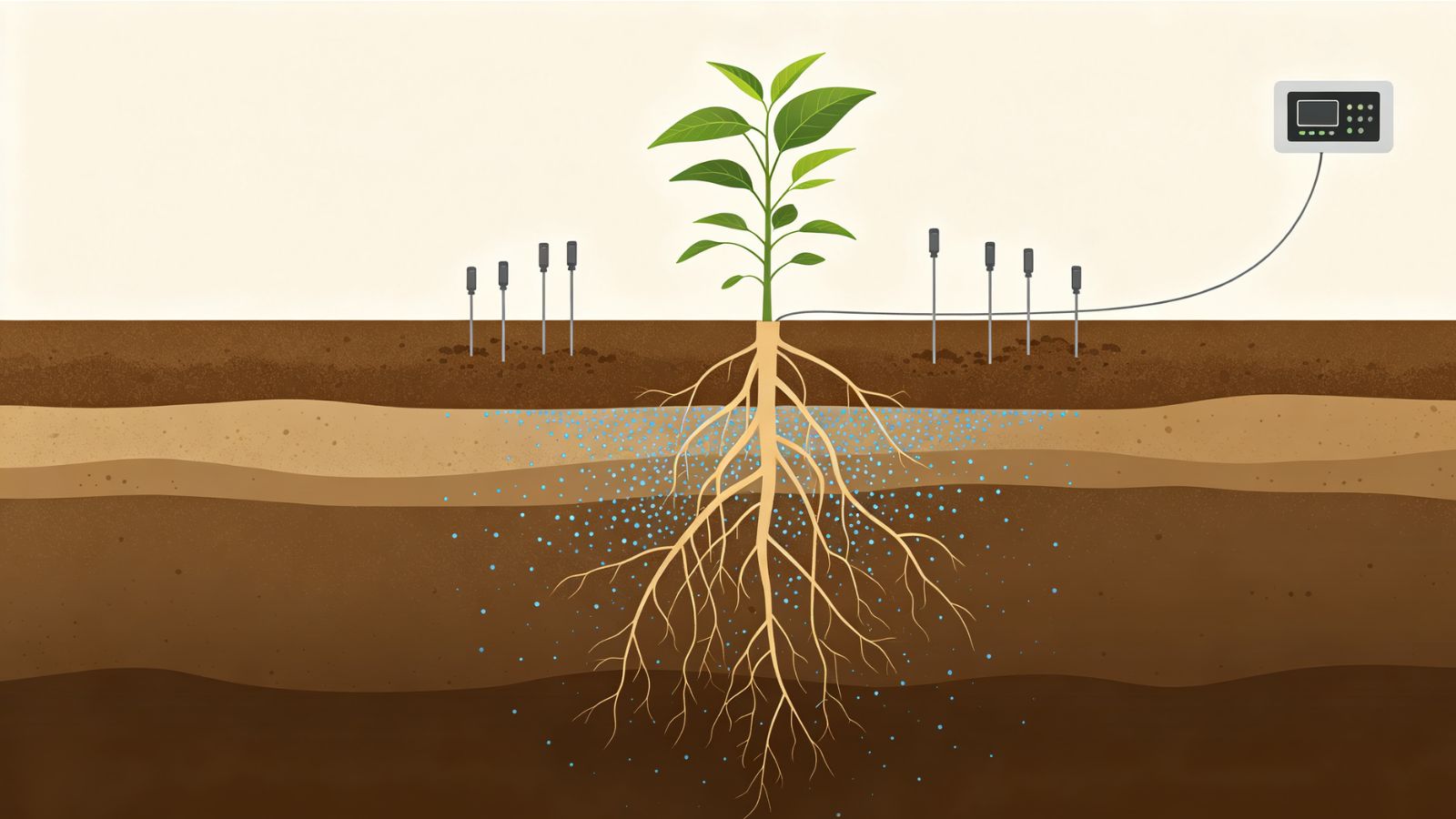
Soil moisture sensors address a major limitation of weather-based irrigation by measuring conditions directly in the root zone. Instead of estimating water loss only from weather information, these sensors provide feedback about how much moisture is actually available in the soil.
When connected to a smart controller, soil sensors can delay irrigation when the landscape already has enough moisture. This is particularly useful after rainfall or in landscapes where different areas dry at different speeds. A shaded planting bed, for example, may still contain sufficient moisture while a nearby sunny area requires additional irrigation.
Sensor placement is critical for accurate results. A sensor installed too close to a sprinkler head may receive unusually high amounts of water, while a sensor placed in an unrepresentative location may not reflect the conditions experienced by most plants. Good installation considers plant type, irrigation zones, soil characteristics, and typical moisture patterns.
Maintenance also matters. Soil contact, wiring problems, calibration issues, and physical damage can affect sensor accuracy. A sensor should be considered a decision-support tool rather than a replacement for proper irrigation design.
EPA WaterSense also recognizes soil moisture-based irrigation controllers as a method for improving watering efficiency because these systems can measure soil conditions and prevent unnecessary irrigation when plants do not require additional water.
While ET data and soil sensors help determine when irrigation should occur, the delivery method determines how efficiently water reaches plants. Drip irrigation improves precision by applying water slowly near plant root zones when the system is properly designed and installed.
Traditional spray sprinklers distribute water over a broad area, which can create losses from wind drift, evaporation, and overspray onto sidewalks, driveways, and other areas without vegetation. Drip systems use tubing and emitters to deliver controlled amounts of water closer to where plants can absorb it.
This approach is especially useful for landscapes containing shrubs, trees, vegetable gardens, and ornamental planting beds. It is also valuable for irregularly shaped areas where spray irrigation can be difficult to manage effectively.
However, drip irrigation is not automatically efficient simply because it uses less visible water. Proper filtration, pressure regulation, emitter selection, and regular inspections are necessary for reliable performance. Clogged emitters, damaged tubing, or poor system design can prevent plants from receiving enough moisture.
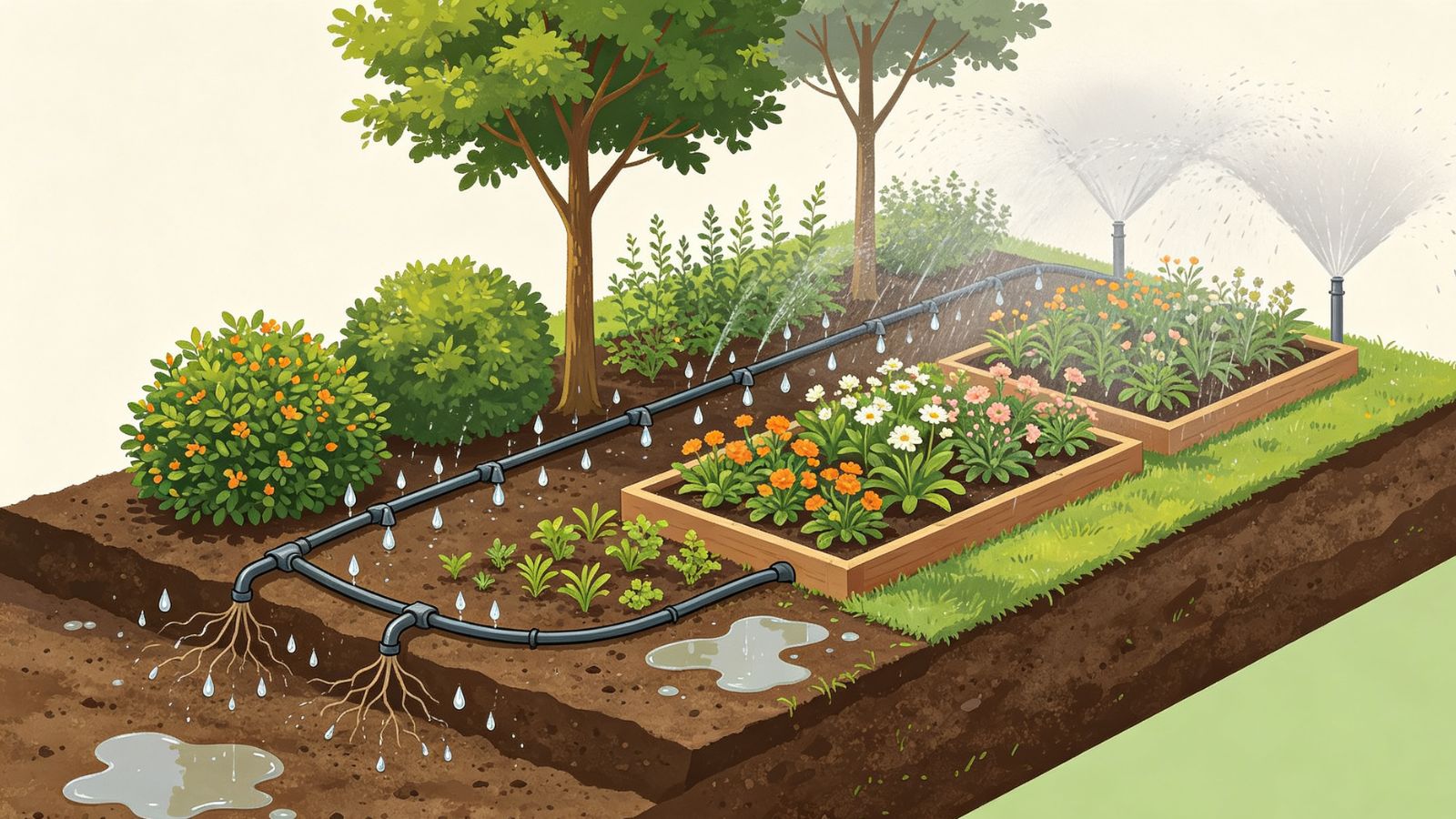
The greatest improvements usually come from connecting better information with an irrigation system that is properly designed and managed. ET data provides information about atmospheric water demand, soil sensors reveal actual moisture conditions, and drip irrigation improves how water reaches plant roots.
A typical suburban landscape may contain several areas with very different irrigation needs, even within the same property. For example, a homeowner in California may have a front lawn exposed to afternoon sun, shaded planting beds beneath mature trees, and drought-tolerant shrubs along a driveway. During a hot summer period, ET data may indicate that overall water demand has increased, but soil sensors may show that shaded areas still contain adequate moisture while exposed areas are drying more quickly. A properly programmed controller can respond by adjusting irrigation based on these differences instead of applying the same schedule across the entire landscape.
This approach is especially effective when landscapes are divided into irrigation zones. Plants with different water requirements should generally not share identical watering schedules. A lawn, drought-tolerant native plants, and established trees may all require different irrigation strategies.
Regional climate also plays a major role in determining how these technologies should be used. A landscape in California does not experience the same irrigation challenges as one in Florida or the desert Southwest.
Local climate conditions influence both plant water demand and irrigation strategy. Weather patterns, seasonal rainfall, humidity levels, and plant selection determine how quickly landscapes lose moisture.
In California’s Mediterranean climate, summers are typically dry while much of the annual rainfall occurs during cooler months. Residential landscapes often experience significant seasonal changes in irrigation demand, making weather-based controllers and ET data useful tools for adjusting schedules. A program that works well in spring may provide too much or too little water during peak summer conditions.
In the Southwest, including parts of Arizona, Nevada, and New Mexico, high temperatures and limited rainfall create additional pressure on outdoor water use. Many landscapes in these regions rely on drought-adapted plants, efficient irrigation zones, and targeted watering methods. Drip irrigation is often used for trees and shrubs because it can deliver water directly to planting areas while reducing unnecessary evaporation.
Humid regions present different challenges. In parts of the Southeast, rainfall events can provide substantial moisture, but irrigation systems may still operate on outdated schedules. Soil moisture sensors can help determine whether additional watering is necessary after periods of rainfall.
This regional approach explains why there is no universal irrigation schedule that works for every home. Effective water management depends on combining climate information, soil conditions, plant selection, and properly designed irrigation equipment.
As smart irrigation becomes more common in residential landscapes, homeowners increasingly rely on guidance from water-efficiency programs and irrigation professionals to understand how these systems should be designed and maintained. Proper installation, programming, and ongoing evaluation are just as important as the equipment itself because even advanced controllers and sensors cannot compensate for poorly designed irrigation systems.
The U.S. Environmental Protection Agency’s WaterSense program evaluates irrigation controllers based on performance criteria and recognizes both weather-based and soil moisture-based technologies that can help improve watering decisions when properly installed, programmed, and maintained.
Research-based recommendations are also available through university extension programs supported through the USDA Cooperative Extension network. These programs provide region-specific guidance on topics such as plant selection, soil management, and landscape practices, which are important because irrigation needs vary significantly across the United States.
Professional groups such as the Irrigation Association provide education and industry standards related to irrigation design, installation, and management. These resources emphasize that efficient irrigation depends on more than equipment alone. System design, correct zoning, maintenance, and regular evaluation remain essential parts of responsible landscape water management.
A smarter irrigation system still requires proper management. Installing a smart controller or adding sensors alone does not automatically create an efficient landscape. Smart controls can only provide useful guidance when the underlying irrigation system is designed correctly.
For some homeowners, improving an existing irrigation system may provide greater benefits than immediately adding smart technology. Fixing leaks, correcting sprinkler coverage, and separating irrigation zones can often solve major efficiency problems first. In many cases, improving the foundation of the system allows future smart controls and sensors to work more effectively.
For example, a homeowner with a 15-year-old sprinkler system may assume that installing a smart controller is the first step toward saving water. However, an inspection may reveal that several sprinkler heads are misaligned, some zones combine plants with different water requirements, and a few areas have uneven coverage. In this situation, correcting those underlying problems may improve irrigation performance before adding sensors or advanced controls.
Poor sprinkler placement, leaks, incorrect programming, or unsuitable plant choices can continue to waste water even with advanced controls. Regular inspections and seasonal adjustments are often necessary because landscape conditions change as plants mature and weather patterns shift.
Another common misunderstanding is that more frequent watering always produces healthier plants. Many established landscapes benefit from irrigation practices that encourage deeper root development, although the ideal approach depends on plant species, soil conditions, climate, and local recommendations.
Homeowners also do not always need the most advanced equipment available. Basic improvements, including repairing leaks, adjusting sprinkler coverage, replacing inefficient spray zones, and grouping plants with similar water requirements, can significantly improve irrigation performance before adding additional technology.
Residential irrigation is gradually moving away from fixed schedules and toward systems that use better information about weather, soil conditions, and plant needs. ET data, soil moisture sensors, and efficient irrigation methods give homeowners more accurate tools for making watering decisions, but these tools work best when they are part of a well-designed landscape plan.
A homeowner does not need to replace an entire irrigation system at once to improve water management. Many successful upgrades begin with practical steps, such as correcting sprinkler coverage, separating irrigation zones, adjusting seasonal schedules, and identifying areas where plants have different watering needs.
Over time, combining thoughtful maintenance with better irrigation information can help create landscapes that are healthier, more adaptable, and better suited to local conditions. The most effective systems are not necessarily the most automated ones—they are the systems that deliver the right amount of water to the right areas based on how each landscape actually functions.
