The water flowing from a kitchen faucet appears simple, but reaching that point requires a carefully coordinated system that combines public infrastructure with private plumbing. In a typical U.S. home connected to a municipal water supply, water travels from a treatment facility through underground distribution mains, enters the property through a service line, passes through meters and control valves, and then moves through a network of pipes that delivers water throughout the building.
Understanding this pathway helps homeowners do more than learn how plumbing works. It provides a practical way to identify where problems may occur, whether the issue is related to the municipal supply, the service connection, pressure regulation equipment, or the plumbing inside the home. It also helps answer an important question that many homeowners face: which parts of the water system are maintained by the utility, and which parts are the homeowner’s responsibility?
Municipal water delivery begins at a treatment facility, where water is processed and monitored before entering the public distribution system. Local water utilities move treated water through large underground pipes known as water mains, which typically run beneath streets and supply multiple properties within a service area.
The connection between a neighborhood water main and an individual house is called a water service line. This smaller pipe carries water from the public distribution system to the building’s plumbing entrance. The service line may enter a home through different locations depending on regional construction methods, climate, and the design of the property.
In colder regions, homes often have basements where the water service enters through the foundation wall into a protected mechanical area. Keeping meters and plumbing equipment indoors helps reduce the risk of freezing during winter conditions. Homes built with crawl spaces may have the service line entering through a foundation wall or below-floor access area, where pipes must still be protected from moisture and temperature changes. In many warmer regions, especially areas where slab foundations are common, plumbing systems may be routed differently because there is no basement or crawl space available. The water service routing may depend on regional construction practices, and entry points are often located through dedicated utility areas or other accessible locations.
A common misunderstanding is that the entire water system from the street to the faucet belongs to the water utility. In reality, ownership boundaries vary by location. Generally, utilities maintain public infrastructure such as treatment facilities and water mains, while homeowners are often responsible for portions of the private service line and interior plumbing. However, responsibility for components such as curb stops, meters, and connection points differs among communities and should be confirmed with the local water provider.
This distinction becomes important when repairs are needed. A damaged municipal water main is typically handled by the utility, while a leak in a privately owned service line may require homeowner involvement, permits, and qualified repair work.
The material and condition of a service line can also affect long-term performance. Older homes may contain galvanized steel service pipes, which can develop internal corrosion and gradually restrict water flow. Copper has been widely used because of its durability, while modern residential construction often uses approved plastic piping materials that can offer installation advantages and resistance to certain types of corrosion. A deteriorating service line may contribute to reduced flow even when the municipal water system is operating normally.
For homeowners evaluating an older property, understanding the approximate age and material of the service line can provide useful information. Building records, utility documentation, or visible plumbing sections near the entry point may help identify the type of connection, although professional inspection may be required for accurate evaluation.
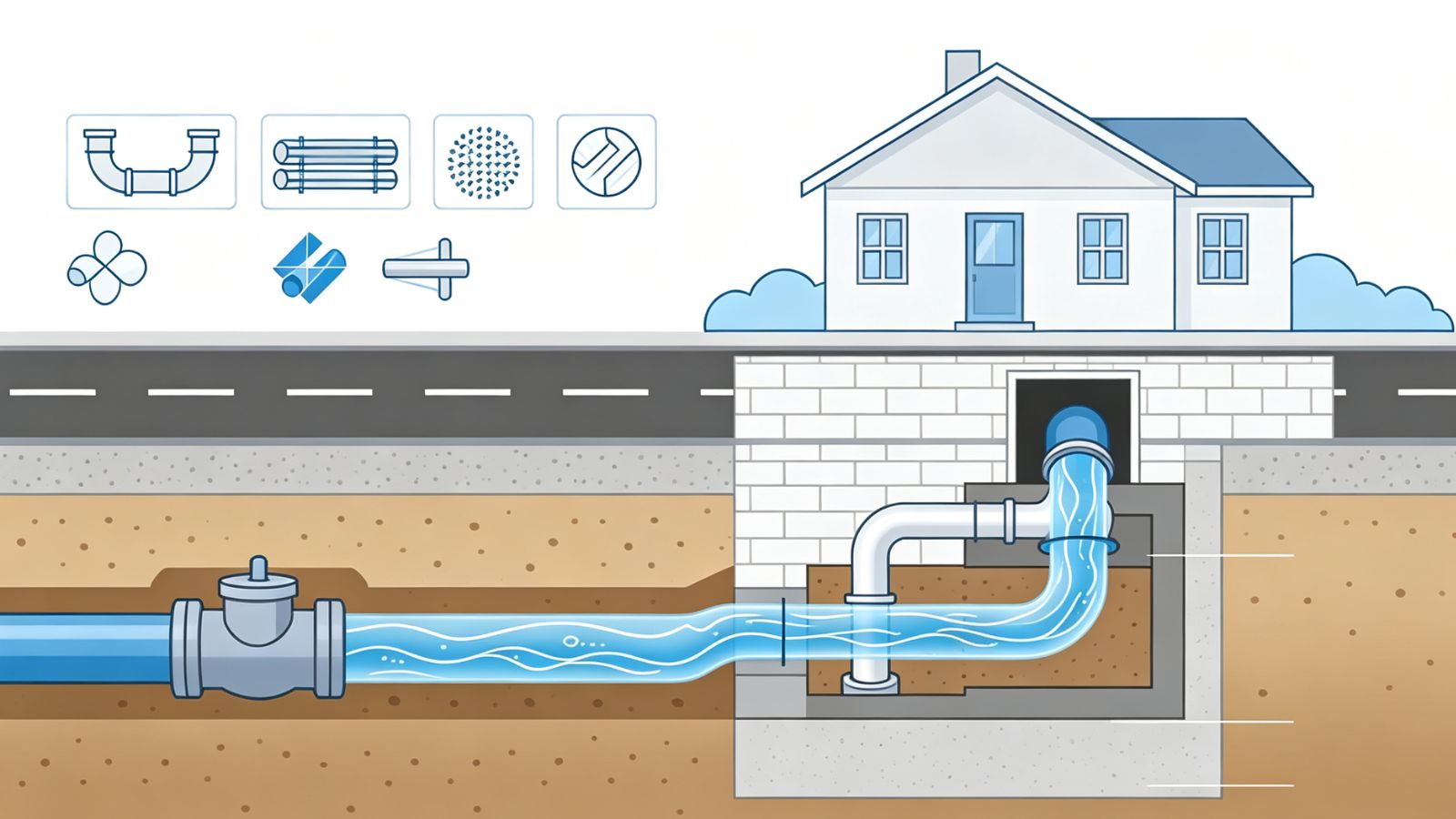
After water travels through the service line, it usually passes through a water meter before entering the home’s internal plumbing system. The meter measures water consumption so the utility can calculate usage, manage demand, and monitor the performance of the distribution system. Many utilities have adopted electronic or smart meter technology that allows remote readings, although adoption varies by utility and region.
The water meter can also provide useful information when investigating possible leaks. If the meter continues recording water usage while all faucets, appliances, and fixtures are turned off, it may indicate that water is flowing somewhere on the property. This does not identify the exact cause of the problem, but it can help homeowners recognize that further inspection may be needed.
Residential water systems also include shutoff valves that allow water flow to be controlled. The homeowner’s main shutoff valve controls water entering the building and is one of the most important emergency components in the plumbing system. If a supply pipe fails, a connection leaks, or a fixture line breaks, closing the main valve can significantly reduce potential water damage.
The location of these components depends heavily on regional construction practices. A basement home may have the meter and shutoff valve mounted along a foundation wall, while a slab-foundation home may have equipment located in an exterior box or utility area. Because emergencies often happen unexpectedly, homeowners benefit from knowing where these components are located before a problem occurs.
Municipal water systems must maintain enough pressure to move water across large service areas and provide reliable flow to customers. However, the pressure available in a public water main is not always appropriate for every residential plumbing system.
A pressure-reducing valve (PRV) is a mechanical device that lowers incoming water pressure before it reaches household pipes and fixtures. The valve adjusts water flow automatically to maintain a safer pressure level within the home’s plumbing system.
Pressure regulation protects more than faucets. Excessively high pressure can place additional stress on supply pipes, valves, appliance connections, and water heaters. Over time, elevated pressure may contribute to leaking fixtures, noisy plumbing, or premature wear of certain components. However, high pressure is only one possible cause of plumbing problems. Leaks may also result from aging materials, installation issues, corrosion, or mechanical failures.
Not every home requires a PRV. Some properties receive municipal water pressure that is already suitable for residential use, while others need pressure control because of elevation differences, local distribution design, or utility system conditions.
A malfunctioning pressure regulator can create confusing symptoms. Homeowners may notice pressure that feels unusually strong, sudden changes in flow, or inconsistent performance throughout the house. However, diagnosing pressure issues requires looking at the entire system rather than replacing a single component automatically.
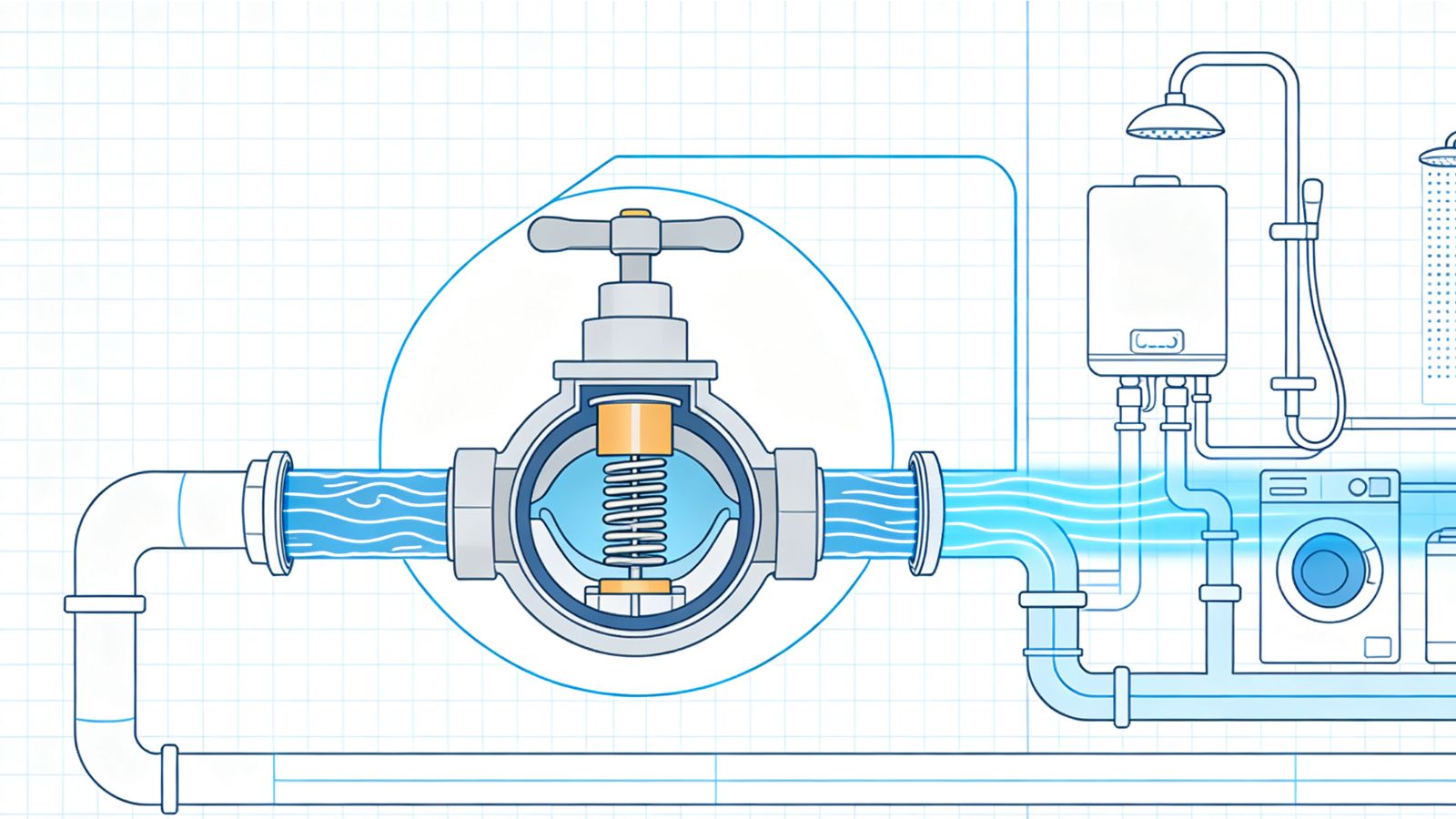
Once water enters the home, it becomes part of the building’s internal distribution system. The incoming supply pipe divides into smaller lines that deliver water to fixtures such as kitchen faucets, bathroom sinks, showers, toilets, washing machines, dishwashers, and outdoor hose connections.
Residential plumbing design involves balancing water volume, pressure, and convenience. The main supply line must provide enough capacity for household demand, while branch lines must distribute water efficiently without excessive pressure loss. Pipe sizing, layout, material selection, and fixture placement all influence how well the system performs.
Many newer homes use manifold or home-run plumbing designs. In these systems, separate supply lines run from a central manifold to individual fixtures. This approach can simplify maintenance because each fixture has its own dedicated line and may reduce pressure fluctuations when several fixtures operate simultaneously.
Older homes often use trunk-and-branch systems, where a larger supply pipe feeds several smaller branches. These systems can function effectively when properly designed, but performance may decline as pipes age. Mineral buildup, internal corrosion, outdated pipe sizing, and aging valves can gradually reduce available flow.
The water entering the home is normally cold. A branch from the main supply line feeds the water heater, where water is heated and distributed through separate hot-water pipes to fixtures that require it. This separation allows the home to supply hot and cold water throughout the building at the same time.
Low or inconsistent water pressure is one of the most common plumbing complaints, but the cause is not always easy to identify. The problem may originate in the municipal supply, the service line, the pressure regulator, or the internal plumbing system. Before replacing parts or scheduling repairs, homeowners can often narrow down the possible source by observing where and when the pressure problem occurs.
A useful first step is determining whether the issue affects the entire house or only specific fixtures. If every faucet, shower, and appliance appears to have reduced flow, the problem may involve the incoming water supply, the service line, the main shutoff valve, or the pressure-reducing valve. If only one fixture is affected, the cause is more likely to be local, such as a clogged aerator, restricted shower valve, partially closed fixture valve, or buildup inside a branch pipe.
The type of water affected can also provide useful clues. If both hot and cold water fixtures have reduced pressure, the issue may be located earlier in the system, such as the service connection or whole-house plumbing. If only hot water fixtures are affected while cold water pressure remains normal, the problem may be related to the water heater, hot-water piping, or a component installed on the hot-water side of the system.
For example, a homeowner may notice that an outdoor faucet near the service entrance has strong flow while an upstairs shower has weak pressure. This situation suggests that the municipal supply and service line may not be the primary problem. The restriction could exist inside the home, possibly in older piping, a partially closed valve, or a fixture component.
Another common situation occurs when multiple fixtures operate at the same time. A shower may temporarily lose some flow when a washing machine begins filling because both fixtures are drawing water from the same distribution system. Proper plumbing design reduces this effect, but small pressure changes are normal in many homes.
Older properties require additional attention because pipe deterioration often develops slowly. Internal corrosion in galvanized pipes, sediment accumulation, or aging valves may reduce available flow over many years. Since these changes happen gradually, homeowners may only recognize the problem after water performance has noticeably declined.
By comparing which fixtures are affected, whether the issue occurs throughout the home, and whether hot or cold water is involved, homeowners can create a more accurate picture of where the problem may exist. This type of basic troubleshooting does not replace professional inspection, but it helps prevent unnecessary repairs and provides useful information when discussing the issue with a plumber.
Consider a homeowner living in a 1960s house who notices that the shower pressure has gradually decreased over several years. The kitchen faucet works normally, but the upstairs bathroom has weak flow, especially during busy morning hours.
The first assumption may be that the city water supply is inadequate, but checking multiple locations can reveal a different picture. If an outdoor faucet near the service entrance still produces strong flow, the municipal supply and service line may not be the primary problem.
Further inspection could reveal that the home still has older galvanized steel pipes. Over decades, corrosion may have reduced the internal opening of the pipe, limiting how much water can reach distant fixtures. In another situation, the problem might be a partially restricted shutoff valve, a failing pressure regulator, or a clogged shower valve.
This example shows why diagnosing plumbing problems requires following the path of water through the entire system. A pressure complaint at one fixture does not automatically indicate a problem with the city supply. Understanding the relationship between the service line, pressure control equipment, and interior plumbing helps narrow down the possible causes before repairs begin.
The components that bring municipal water into a home generally operate continuously for decades with limited maintenance, but homeowners can reduce problems by understanding their system and monitoring for warning signs.
Important signs that deserve attention include unexplained increases in water bills, damp areas near the foundation, sudden drops in pressure, visible corrosion around plumbing connections, unusual pipe noises, or repeated fixture problems. These signs do not always indicate a major failure, but they can help identify issues before they become more expensive repairs.
Homeowners should also understand that work involving service lines, water meters, pressure regulators, or connections to public infrastructure may require permits or licensed professionals depending on local regulations. Plumbing codes and utility requirements exist to protect drinking water quality, prevent contamination, and ensure repairs meet safety standards.
Knowing the location of the main shutoff valve, water meter, and visible plumbing entry point is one of the simplest ways to prepare for future problems. These components provide valuable information during troubleshooting and allow faster action during emergencies.
The journey of municipal water into a house involves several connected stages: treatment facilities, distribution mains, service lines, meters, shutoff valves, pressure-control equipment, and interior plumbing. A failure at any stage, from the service line to the interior branch pipes, can change how much water reaches household fixtures.
The public water system delivers treated water through underground infrastructure, while the service line creates the physical connection between the utility network and the home. The meter records usage, valves allow the system to be isolated when necessary, pressure regulation helps protect household plumbing, and interior pipes distribute water to individual fixtures.
For homeowners, understanding this process turns an invisible utility system into something much easier to manage. When water pressure changes, leaks appear, or repairs become necessary, knowing how water travels through the property helps identify possible causes and determine what type of solution may be required.
