Understanding household electricity use has traditionally required a tradeoff between measurement complexity and data resolution. If a homeowner wants to know how much electricity a refrigerator, heat pump, water heater, or washing machine uses, the most direct approach is to measure those loads separately with dedicated submeters or monitoring devices. That approach can produce detailed information, but installing and maintaining sensors across many appliances or circuits is not always practical.
Non-Intrusive Load Monitoring (NILM), also called energy disaggregation, takes a different approach. Instead of measuring every appliance independently, a NILM system analyzes electricity measurements collected at a single point, such as a utility meter or main electrical panel, and attempts to infer which individual loads are operating within the aggregate signal. The important word is infer: NILM does not directly measure every appliance. It estimates appliance activity from patterns in the combined electrical data, making it a computational alternative to extensive end-use metering rather than a perfect substitute for it. Research from the National Renewable Energy Laboratory has likewise noted that NILM can provide useful end-use information while generally remaining less accurate than direct end-use metering.
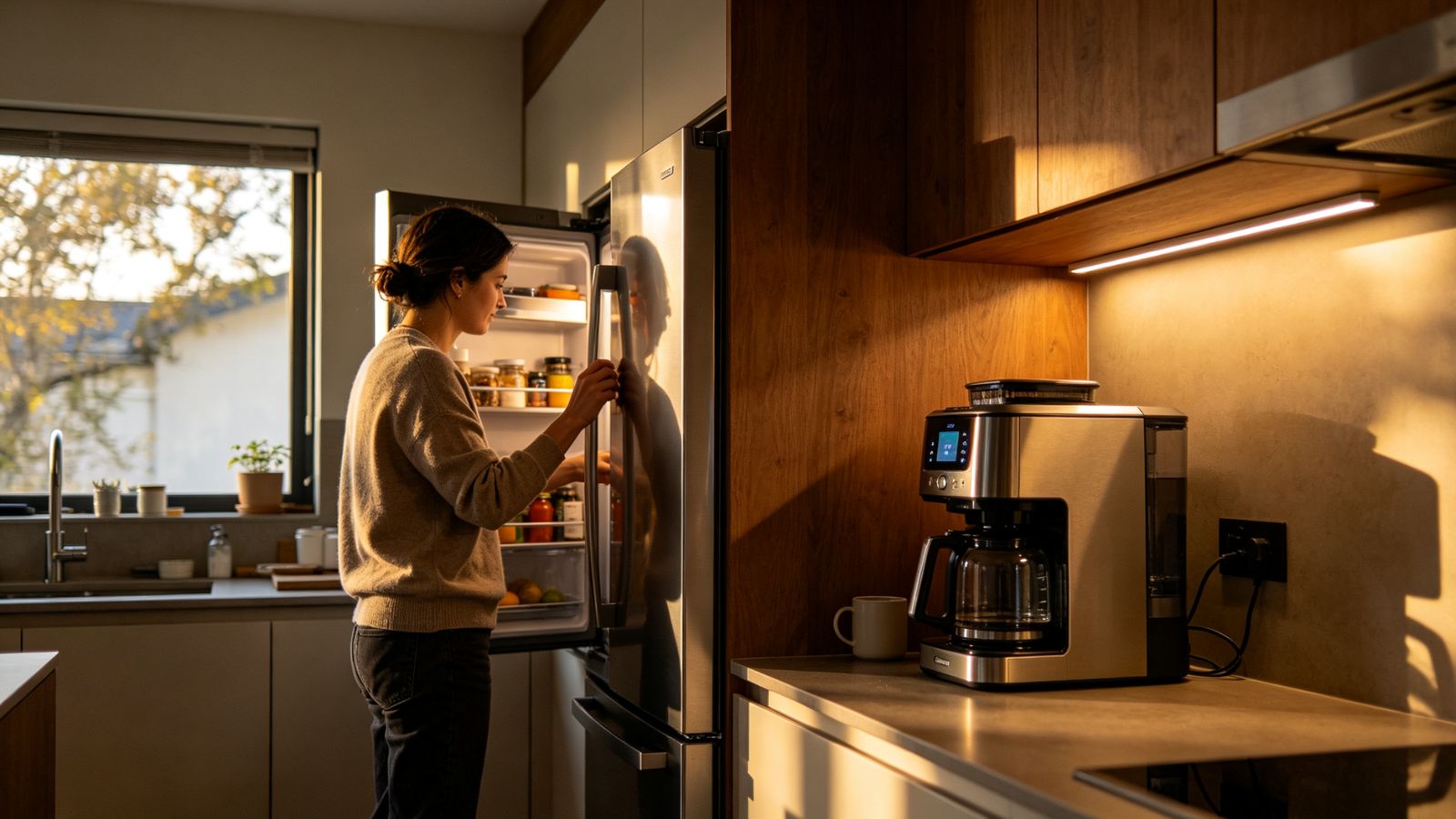
A household electrical meter normally observes the combined demand of many devices rather than a separate signal for each appliance. At one moment, a refrigerator compressor might start while a heat pump is already operating, lighting is switched on, and electronic equipment remains in standby. The meter records the resulting aggregate demand, but it does not inherently label which portion belongs to which device.
This creates the fundamental NILM problem: the algorithm observes the result and must infer the components that produced it. In mathematical terms, the system is attempting to estimate several hidden appliance-level signals from one or more aggregate measurements. The problem becomes increasingly difficult when appliances operate simultaneously, when different devices produce similar electrical patterns, or when a single appliance changes its operating state continuously rather than switching cleanly between on and off. These conditions are common in modern homes, which means successful disaggregation depends on recognizing patterns over time rather than simply matching one instantaneous power value to one appliance.
A useful way to visualize the process is to imagine an aggregate household load rising by several hundred watts. That increase could represent a heating element, a motor, an electronic power supply, or several smaller devices starting at nearly the same time. A single measurement may not contain enough information to distinguish those possibilities. NILM therefore looks for additional evidence, including the size and direction of power changes, how long a load remains active, whether similar patterns repeat, and how the signal evolves before and after an apparent event. The objective is not to find a permanently unique fingerprint for every appliance, but to estimate the most plausible appliance states from incomplete and overlapping evidence.
The information available to a NILM system depends heavily on how the electricity is measured. Some systems work primarily with active power, while others can incorporate reactive power, voltage and current characteristics, or higher-frequency waveform information. More detailed measurements can expose features that disappear when electricity data is recorded only at relatively long intervals.
One traditional approach is event detection, which looks for meaningful changes in electrical demand. A resistive heating element may produce a relatively clear increase in active power when it switches on, while a motor-driven appliance may create a different combination of active and reactive power as its motor starts and operates. These changes can provide useful clues, but they are not guaranteed to be unique. A toaster and another resistance-based heating device, for example, can produce broadly similar power changes, while several motor-driven appliances may overlap in their electrical behavior.
Higher-frequency measurements can provide additional information. Electrical transients, harmonics, and other waveform characteristics may reveal details about switching electronics, motors, compressors, and power supplies that are invisible in coarse interval data. However, these features should not be treated as universal appliance identifiers. Their usefulness depends on the equipment, measurement system, sampling rate, electrical environment, and quality of the available data. In practical NILM applications, the strongest systems generally combine multiple characteristics rather than relying on one supposedly unique signature. NREL has noted that NILM approaches using higher-frequency data and measurements of both real and reactive power can have greater disaggregation capability than approaches with less detailed inputs.
Early NILM approaches relied heavily on manually defined rules. An algorithm might be programmed to look for a particular change in power and associate that event with an appliance whose expected operating characteristics matched the observation. This approach can work reasonably well when appliances have distinctive, repeatable operating cycles, but household environments quickly expose its limitations. Modern equipment often has multiple operating states, variable-speed motors, electronic controls, and changing power requirements.
Machine learning changed the problem from manually specifying every possible rule to learning patterns from data. A supervised model can be trained using aggregate household measurements paired with appliance-level reference measurements, allowing the system to learn relationships between the combined signal and known appliance activity. Other approaches use semi-supervised, unsupervised, or transfer-learning techniques to reduce dependence on fully labeled household data. The precise architecture varies by application, but sequence-based neural networks, convolutional models, recurrent networks, and more recent deep-learning approaches have all been investigated for energy disaggregation.
The key advantage of sequence-based learning is that an appliance does not have to be identified from one measurement alone. A washing machine, for example, may produce a sequence of different electrical states during filling, heating, agitation, spinning, and standby. A model can use the progression and timing of those states as evidence rather than treating every power change as an independent event. The same principle applies to HVAC equipment, refrigerators, dishwashers, and other devices whose operating behavior unfolds over time. In this sense, NILM is closer to pattern recognition over a time series than to simple appliance classification.
The hardest NILM problem is often not recognizing a large appliance in isolation but separating several plausible explanations for the same aggregate signal. Overlapping loads are a fundamental challenge. If a heat pump, electric water heater, and several smaller appliances operate simultaneously, their individual contributions become superimposed. Even a highly capable model may have difficulty determining exactly how much energy belongs to each device when the available measurements do not contain enough distinguishing information.
Another problem is similarity between appliance signatures. Two devices can consume comparable amounts of power while operating for similar periods, making it difficult to distinguish them using coarse measurements. This problem becomes more pronounced for low-power electronics, lighting, and other loads whose individual contribution may be small relative to the household background load.
Modern variable-speed equipment introduces a different complication. Older appliances are often easier to represent as discrete states such as off and on, while inverter-driven heat pumps, electronically controlled refrigerators, and other variable-load equipment can change power continuously. Their consumption may rise and fall without producing a clean step change. Computers and other electronic devices can be similarly difficult because their power requirements depend on what they are doing at a particular moment. These characteristics make the household signal less like a collection of simple switches and more like a continuously changing mixture of operating states.
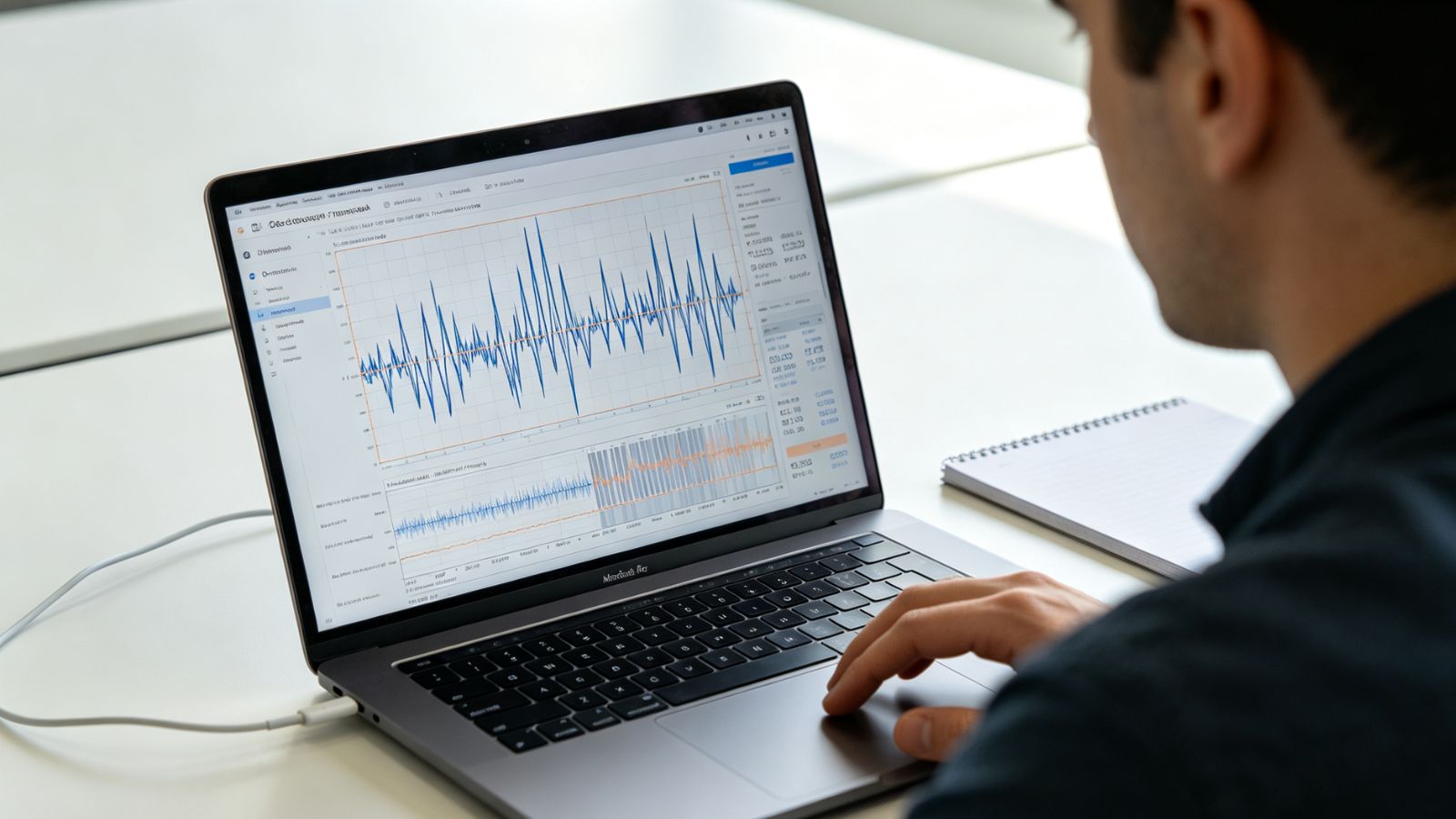
The quality of NILM inference is closely connected to the quality of the underlying electricity data. A high-frequency measurement system can capture short-lived electrical events and waveform characteristics that disappear when the same information is reduced to longer intervals. By contrast, a utility interval dataset may provide measurements at intervals such as 15 minutes, 30 minutes, or an hour, depending on the metering system and what data is made available to the customer or analyst.
This distinction matters because meter data resolution and the electrical sampling performed inside a metering system are not necessarily the same thing. A system may collect detailed measurements internally while exposing customers or third-party analysts only a summarized interval dataset. Once rapid transients and short operating events have been averaged away, an algorithm cannot reconstruct information that is no longer present in the available input.
Lower-resolution data can still be useful. A long-running air conditioner or water heater may leave a recognizable pattern even when individual switching events are invisible, particularly when weather and other contextual information are available. Larger and more distinctive loads can therefore be better candidates for NILM than small appliances with similar power requirements. NREL has specifically identified larger, more distinctive loads and loads correlated with observable conditions such as weather-sensitive air conditioning as favorable applications, while noting that direct end-use metering remains more accurate when high precision is required.
A sophisticated model cannot eliminate the limitations of the data used to train it. Appliance behavior varies by manufacturer, model, age, installation, household routines, and electrical environment. A neural network trained primarily on one group of homes may encounter very different operating patterns when deployed in another group. This creates a generalization problem: the model must recognize meaningful appliance behavior without simply memorizing the characteristics of the households represented in its training data.
Training datasets can also introduce a practical tension. The most useful way to know what an individual appliance is actually doing is to measure that appliance directly, yet the purpose of NILM is partly to reduce the need for extensive appliance-level measurement. Research systems can therefore use detailed submetered data to create labeled training examples even when the eventual deployment is intended to rely primarily on aggregate measurements. The quality, diversity, and representativeness of those reference datasets influence how well a model can perform outside its original training environment.
This is one reason NILM results should be treated as estimates rather than unquestionable measurements. A model can produce a plausible appliance-level breakdown while still assigning some energy incorrectly between similar or simultaneously operating devices. The more specific the intended application, the more important it becomes to understand the uncertainty surrounding the estimate rather than presenting every inferred value as a directly measured fact.
The appeal of NILM is straightforward: one measurement point can potentially provide information about many loads without installing a separate sensor on every appliance. That can reduce installation complexity and create opportunities for applications such as energy feedback, load analysis, demand-response planning, equipment monitoring, and building diagnostics. Earlier NREL work identified appliance-level feedback, equipment performance analysis, and continuous home monitoring as potential applications for NILM-based systems.
However, the convenience comes with a tradeoff. Direct end-use metering measures the appliance or circuit itself, while NILM estimates its contribution indirectly. When a homeowner or utility needs highly accurate measurement of a particular device—for example, to verify equipment performance or precisely quantify a program outcome—direct measurement may still be preferable. NILM is more valuable when the cost, complexity, or scale of installing individual meters makes comprehensive submetering impractical.
This distinction also affects how NILM results should be used. An estimated appliance profile can reveal that a household appears to have unusually high cooling demand, a long-running water-heating load, or an unexpected operating pattern. That information can guide further investigation, but it does not necessarily establish the physical cause. A suspected equipment problem may still require direct testing, inspection, or additional measurement. The strongest applications therefore treat NILM as a diagnostic layer that can identify patterns worth investigating rather than as a universal replacement for physical measurement.
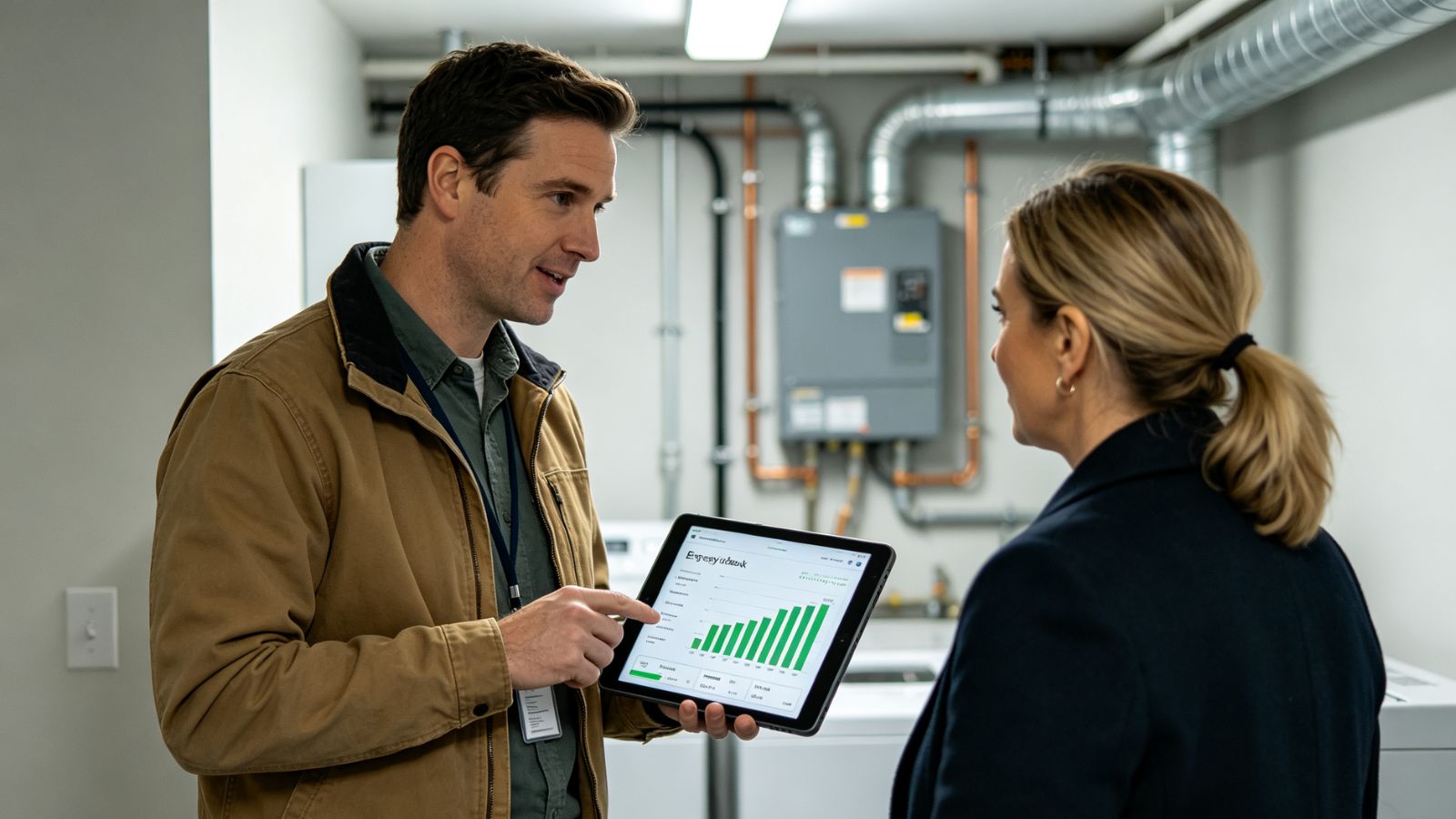
The practical value of NILM comes from what can be done with the inferred information after disaggregation. A conventional monthly electricity bill tells a homeowner how much energy was consumed, while aggregate interval data can reveal when consumption occurred. NILM attempts to add another layer by estimating which types of loads contributed to those patterns.
That additional information can support more targeted analysis. If an algorithm consistently attributes a large portion of overnight demand to a particular class of equipment, an auditor may investigate that load more closely. If cooling demand appears unusually high during mild weather, the result could support a broader examination of HVAC operation, building conditions, thermostat behavior, or equipment performance. In utility programs, appliance-level estimates may also help identify opportunities for demand response or evaluate whether certain efficiency measures changed household load patterns. NREL has described NILM as a potential component of continuous home energy analysis and equipment-focused diagnostics, while also emphasizing the importance of accuracy limitations.
The important point is that NILM adds interpretation, not simply more numbers. The aggregate meter already contains the household's total electrical demand. The challenge is extracting useful structure from that mixture without installing a separate measurement channel for every device. When the inferred results are combined with weather, building characteristics, equipment information, occupancy patterns, or other available data, they can become more informative than the raw meter signal alone.
As smart-meter deployments, edge computing, and machine-learning techniques continue to develop, NILM is becoming increasingly relevant to the broader field of residential energy analytics. Its long-term potential lies less in perfectly identifying every small appliance and more in providing useful end-use information at a scale where conventional submetering would be expensive or difficult.
The most realistic future is therefore likely to involve selective inference rather than perfect reconstruction. Large and distinctive loads may be estimated with greater confidence, while ambiguous low-power devices may remain grouped into broader categories. Systems can also combine electrical data with contextual information to improve interpretation, particularly for loads whose behavior is strongly related to weather or predictable household conditions. This approach aligns with the practical observation that NILM can be especially useful for distinctive loads while remaining less accurate than direct end-use measurement.
NILM ultimately represents a different way of thinking about residential electricity measurement. Instead of asking every appliance to report its own consumption through a dedicated sensor, the system observes the household as a whole and uses electrical patterns, time-series behavior, and statistical inference to estimate what is happening underneath the aggregate signal. That approach cannot remove the fundamental ambiguity created by overlapping loads, limited sampling resolution, changing appliance behavior, and imperfect training data. It can, however, turn a single stream of household electricity measurements into a much richer picture of how major loads operate.
The distinction between measurement and inference is the key to understanding both the promise and the limitations of NILM. A submeter directly records the electricity flowing through a particular circuit or device; NILM estimates that contribution from information collected elsewhere. Used within those limits, the technology can provide a practical middle ground between a single undifferentiated utility meter and a heavily instrumented home. Rather than replacing every form of end-use measurement, NILM is best understood as a computational method for extracting additional information from data that a household or utility may already possess.
