Residential energy management has moved well beyond manual switches and fixed thermostat schedules. As homes add heat pumps, electric water heaters, battery storage, electric vehicle charging, smart appliances, and other flexible electrical loads, the challenge is increasingly about coordinating when equipment operates rather than simply reducing how much electricity the home uses. A household may have several devices capable of drawing substantial power at the same time, while electricity prices, solar production, indoor conditions, and utility demand signals can all change throughout the day.
Automation provides a way to coordinate those competing conditions without requiring occupants to make every adjustment manually. Two fundamental approaches are rule-based control and sensor-informed control. Rule-based systems make decisions according to explicitly defined conditions, schedules, limits, or external signals. Sensor-informed systems use measurements of the home's current physical state—such as temperature, occupancy, or equipment status—to provide information that can influence those decisions. In practice, the distinction is not absolute: many residential energy-management systems combine rules with sensor inputs, creating a layered control process in which measurements inform decisions and predefined logic determines what actions are permitted.

Rule-based automation is built around explicit conditions and actions. A homeowner, installer, utility program, or energy-management platform defines what should happen when a specified condition is met. The condition might be a clock time, an electricity price, a battery state of charge, a temperature threshold, or an external demand-response signal. The important characteristic is that the decision logic is defined in advance rather than being inferred dynamically from an unspecified pattern.
A simple time-based schedule illustrates the concept. An EV charger might be configured to begin charging after a particular off-peak period, while a heat-pump water heater could be scheduled to operate during hours when electricity prices are lower. A battery system might follow a predefined charging and discharging schedule, subject to its operating limits and the conditions established by its control system. More advanced rules can incorporate external information: if a utility sends a demand-response signal, a system may temporarily reduce or defer selected flexible loads according to rules established ahead of time.
The strength of this approach is predictability. Because the operating conditions are explicitly defined, the homeowner or system designer can establish clear boundaries around when a device should operate and what conditions should trigger a response. That predictability can be particularly useful when the objective is straightforward, such as avoiding a known peak-price period or ensuring that a battery maintains a specified reserve. Rule-based control can also be implemented at relatively different levels of complexity, from a simple schedule on an individual device to coordinated logic within a broader home energy management system.
Predictability becomes a limitation when household conditions differ from the assumptions built into the schedule. A thermostat programmed to change its temperature setting at a particular time does not necessarily know whether occupants are still using the room unless another source of information provides that context. Similarly, an appliance scheduled to operate overnight may follow the schedule even if circumstances have changed and the household would prefer a different operating pattern.
This does not mean rule-based systems are incapable of responding to physical conditions. A rule can use a temperature sensor, occupancy signal, electricity price, or equipment measurement as its input. The important distinction is between the decision logic and the information used by that logic. A rule such as “if indoor temperature exceeds a specified threshold, activate cooling” remains rule-based even though the condition comes from a sensor. Treating rules and sensors as completely opposing technologies therefore oversimplifies how real residential control systems are designed.
The more useful distinction is that rules describe how the system should respond to known conditions, while sensors provide measurements that help establish what those conditions actually are. A sophisticated controller can use both: sensors provide current-state information, and explicit rules establish the operating boundaries within which the system can respond.
Sensor-based automation emphasizes measurements from the physical environment or from the equipment itself. Instead of relying only on a clock or predetermined schedule, the control system can incorporate information about what is happening inside the home at the time a decision is made. This can make automation more responsive to conditions that vary from one day to another.
Occupancy sensors are one example. Passive infrared sensors can detect changes associated with movement, while other sensing technologies can provide additional information about presence or room activity. Temperature sensors can identify conditions that differ between zones, and door or window contacts can indicate whether an opening is currently closed or open. Equipment sensors can provide information about whether a compressor, fan, heating element, or other load is already operating.
The usefulness of these measurements depends on what the control system can do with them. A sensor does not automatically save electricity merely because it detects a condition. The measurement must be connected to control logic and a controllable device. If an occupancy sensor determines that a room has remained vacant for a defined period, for example, the automation system might reduce HVAC conditioning or switch compatible lighting and equipment into a lower-power state. The actual result depends on the equipment, configuration, timing, and control strategy.
Sensor-informed automation can respond more closely to real conditions, but that additional responsiveness introduces another layer of complexity. Sensors have measurement ranges, detection limits, placement requirements, communication dependencies, and potential failure modes. A motion sensor may detect movement well but provide weaker evidence when someone remains seated for an extended period. A temperature sensor installed near a window or supply vent may measure a local condition that does not accurately represent the entire room.
Control decisions also have to account for time. If an occupancy system immediately changes HVAC operation whenever a room appears empty, it may create unnecessary cycling when occupants briefly leave and return. A better configuration may require the room to remain vacant for a specified period before changing the operating state. That timeout becomes another control parameter that must be balanced against energy savings, equipment behavior, and occupant comfort.
Connectivity is another consideration in distributed sensor systems. Wireless communication failures, depleted batteries, unavailable cloud services, or controller faults can interrupt normal operation. The resulting behavior depends on the architecture of the particular system and whether it has local control, cached rules, timeout behavior, or other fallback mechanisms. A resilient system therefore needs to account not only for normal sensor readings but also for what should happen when measurements or communications become unavailable.

Residential energy management rarely has to choose between rules and sensors as if only one can be used. In many systems, the two approaches perform different functions and work together. Rules can establish economic, operational, and safety boundaries, while sensor measurements provide information about the home's current state. The resulting control architecture can be understood as a sequence: measurement → decision logic → control action → observed response.
Consider a home with a heat pump, battery storage, and time-varying electricity prices. A rule-based layer might establish when battery charging is permitted, how much reserve should be maintained, or which periods are considered expensive. At the same time, temperature sensors and equipment measurements can show current indoor conditions and whether the heat pump is already operating. The controller can then make decisions within the predefined boundaries instead of blindly following a fixed clock schedule.
The same principle can apply to flexible loads such as water heating. A schedule might establish preferred operating periods, while temperature and equipment-state measurements determine whether additional heating is actually required. This avoids treating every hour as identical. The schedule supplies a framework, while the measurements provide information that allows the system to respond to actual conditions.
One important benefit of coordinated automation is that it can change the timing of electricity consumption. This distinction is easy to overlook because energy efficiency and load management are often discussed together even though they address different problems.
Efficiency measures generally seek to provide the same service with less energy. A more efficient heat pump, for example, may deliver a given amount of heating or cooling with less electricity under comparable operating conditions. Load management, by contrast, may leave total energy consumption relatively similar while moving some of that consumption away from periods of high system demand or high electricity prices.
Automation can support both objectives, but the mechanisms are different. A controller may delay an EV charging session, shift water heating to another period, or temporarily reduce a flexible load during a demand-response event. These actions do not necessarily eliminate the underlying energy requirement. Instead, they alter when that requirement is served. In a household subject to time-of-use rates, that timing change can affect electricity costs; at larger scale, coordinated changes across many homes can also affect the shape of aggregate electricity demand.
Residential peak demand is often shaped by several systems operating within the same period rather than by one appliance alone. A home might simultaneously be heating or cooling, charging an EV, heating water, and operating a cooking appliance. The significance of that combination depends on the home's electrical configuration and the duration of the overlapping loads, but coordination can reduce the likelihood that flexible equipment adds to an already high-demand period.
This is where automation can provide a practical advantage over manual management. A homeowner does not necessarily need to monitor every appliance continuously if the control system can enforce predefined operating priorities. For example, an energy-management system might allow essential loads to continue operating while delaying a flexible load for a short period. The exact hierarchy depends on system design, equipment capabilities, utility programs, and the homeowner's preferences.
Such control should not be confused with unlimited optimization. A residential controller operates within constraints imposed by equipment capacity, electrical safety, battery state, minimum operating times, thermal comfort, water-temperature requirements, communications, and other conditions. Effective automation is therefore less about finding one mathematically perfect schedule and more about making reasonable decisions while respecting those constraints.
Energy automation also has to account for situations in which the normal control process should not be followed. Occupants may need to override an automated temperature setting, a battery may need to preserve energy for backup use, or equipment may need to operate despite a normally restrictive schedule. These exceptions are not flaws in automation; they are part of designing a system that remains useful when real-world conditions differ from the assumptions behind the control strategy.
The quality of a control system can therefore be evaluated partly by what happens outside normal operation. A well-designed system should define how it responds when a sensor becomes unavailable, communication is interrupted, a device reports an error, or an occupant manually changes a setting. Local fallback logic, operating limits, manual overrides, and equipment protection can all affect whether an automation system remains predictable during abnormal conditions.
This is particularly important for thermal equipment. HVAC systems cannot always be treated like simple on-off electrical loads because cycling behavior, minimum run times, thermal inertia, and equipment controls influence how frequently and for how long they operate. An automation strategy that appears efficient when viewed only as a schedule could create undesirable cycling or comfort changes if it ignores the operating characteristics of the controlled equipment.
As the number of controllable devices increases, coordination becomes more important. A single smart thermostat can manage one category of load, but a broader home energy management system can consider several loads simultaneously. The system may receive electricity-price information, solar generation measurements, battery state-of-charge data, indoor temperatures, occupancy signals, and equipment operating states before deciding which flexible loads should operate.
The resulting architecture resembles a small control network rather than a collection of isolated smart appliances. Sensors provide measurements, rules establish constraints and priorities, controllers evaluate conditions, and actuators change the operating state of equipment. Feedback from those devices then provides new measurements, allowing the control process to continue rather than ending after a single command.
This feedback loop is particularly useful because household conditions are constantly changing. Solar generation varies with weather, outdoor temperature changes HVAC demand, occupants change schedules, and batteries move between charging and discharging states. A control strategy that responds only to a fixed schedule can become increasingly disconnected from those conditions. A hybrid system can retain predictable boundaries while using updated measurements to determine when an action is actually appropriate.
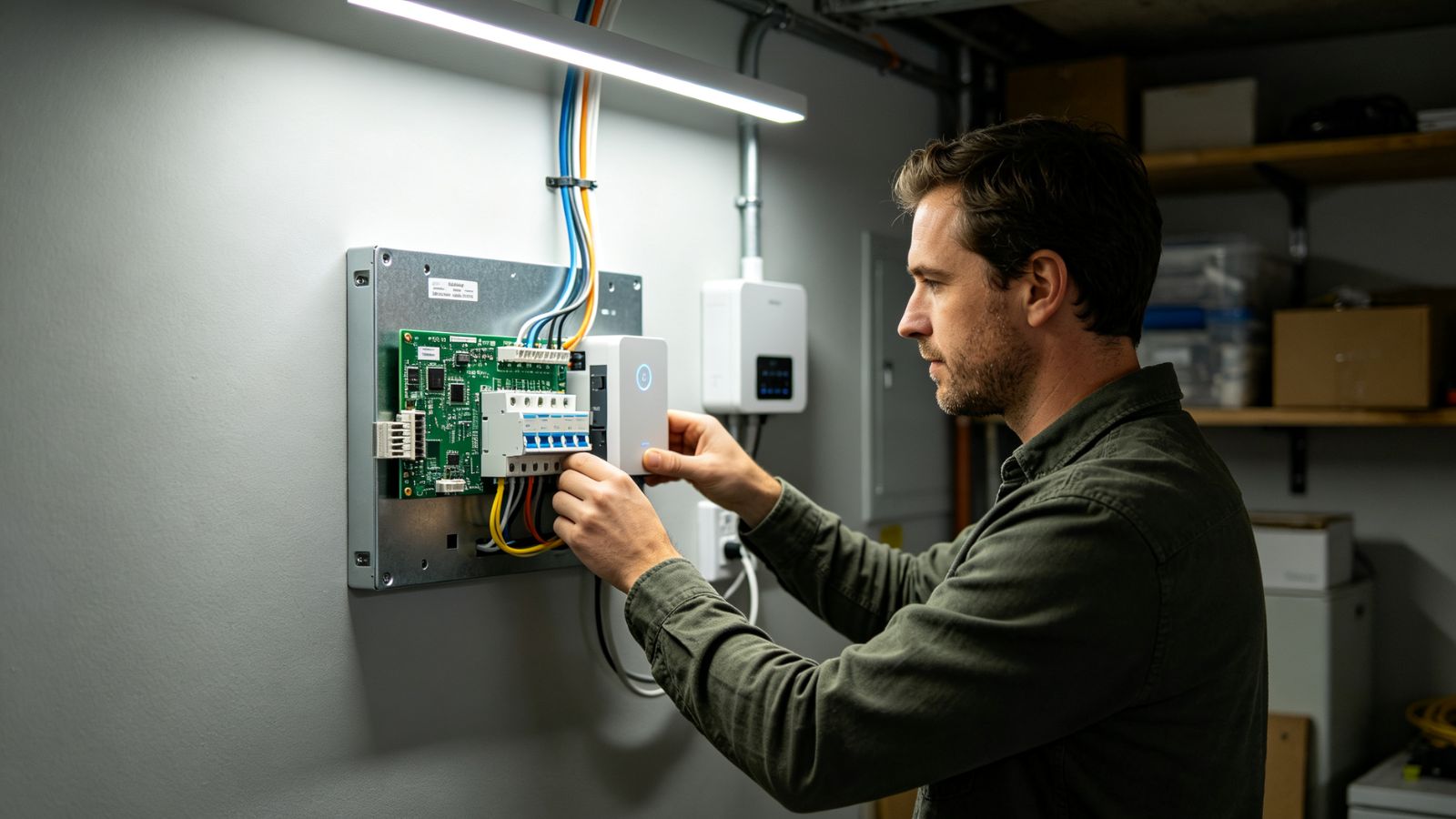
The effectiveness of residential load automation depends less on whether a system is labeled “rule-based” or “sensor-based” than on how well its different components work together. A useful system needs reliable measurements, appropriate control logic, compatible equipment, sensible operating boundaries, and a clear response when normal inputs are unavailable. The objective is not simply to automate as many devices as possible, but to coordinate the loads that can meaningfully affect energy use, timing, cost, or peak demand.
That distinction also helps explain why additional sensors do not automatically produce better energy performance. More data can improve situational awareness, but it can also increase system complexity and create more opportunities for erroneous measurements, conflicting rules, or poorly designed responses. A temperature sensor is valuable when its measurement changes a useful control decision; an occupancy signal is valuable when the system can translate it into an appropriate response. The value comes from the complete control chain, not from the presence of hardware alone.
The same principle applies to rule design. A schedule may work well when household routines are stable, but a more adaptive system may be preferable when occupancy and energy conditions change frequently. Conversely, simple predictable rules may be preferable when the objective is narrow and the operating conditions are well understood. Good residential energy control is therefore a matter of matching the control architecture to the load, the available information, and the consequences of changing its operating state.
Rule-based and sensor-informed automation are best understood as complementary components of residential energy control rather than mutually exclusive alternatives. Rules establish explicit conditions, schedules, priorities, and limits, while sensors provide measurements of the current environment and equipment state. When those elements are connected to suitable control hardware, a home can respond to changing conditions without requiring occupants to manually coordinate every flexible electrical load.
The practical value lies in the complete process: measure the current state, apply the relevant control logic, change an appropriate load, and observe the resulting condition. That process can help shift flexible consumption away from expensive or high-demand periods, reduce unnecessary operation when spaces are unoccupied, and coordinate systems such as HVAC, water heating, batteries, and EV charging. The result is not guaranteed energy savings in every installation, because outcomes depend on equipment, configuration, occupant behavior, tariffs, weather, and system constraints.
The most robust residential automation strategies therefore do not treat intelligence as a feature that comes from sensors alone. They combine reliable measurements with explicit operating rules, appropriate equipment controls, fallback behavior, and feedback. That combination allows automation to remain predictable when conditions are stable while still responding when the physical conditions of the home change. For residential energy management, the central question is not whether rules or sensors are superior, but how effectively measurements and control logic can be combined to manage electrical loads within the real constraints of a household.
