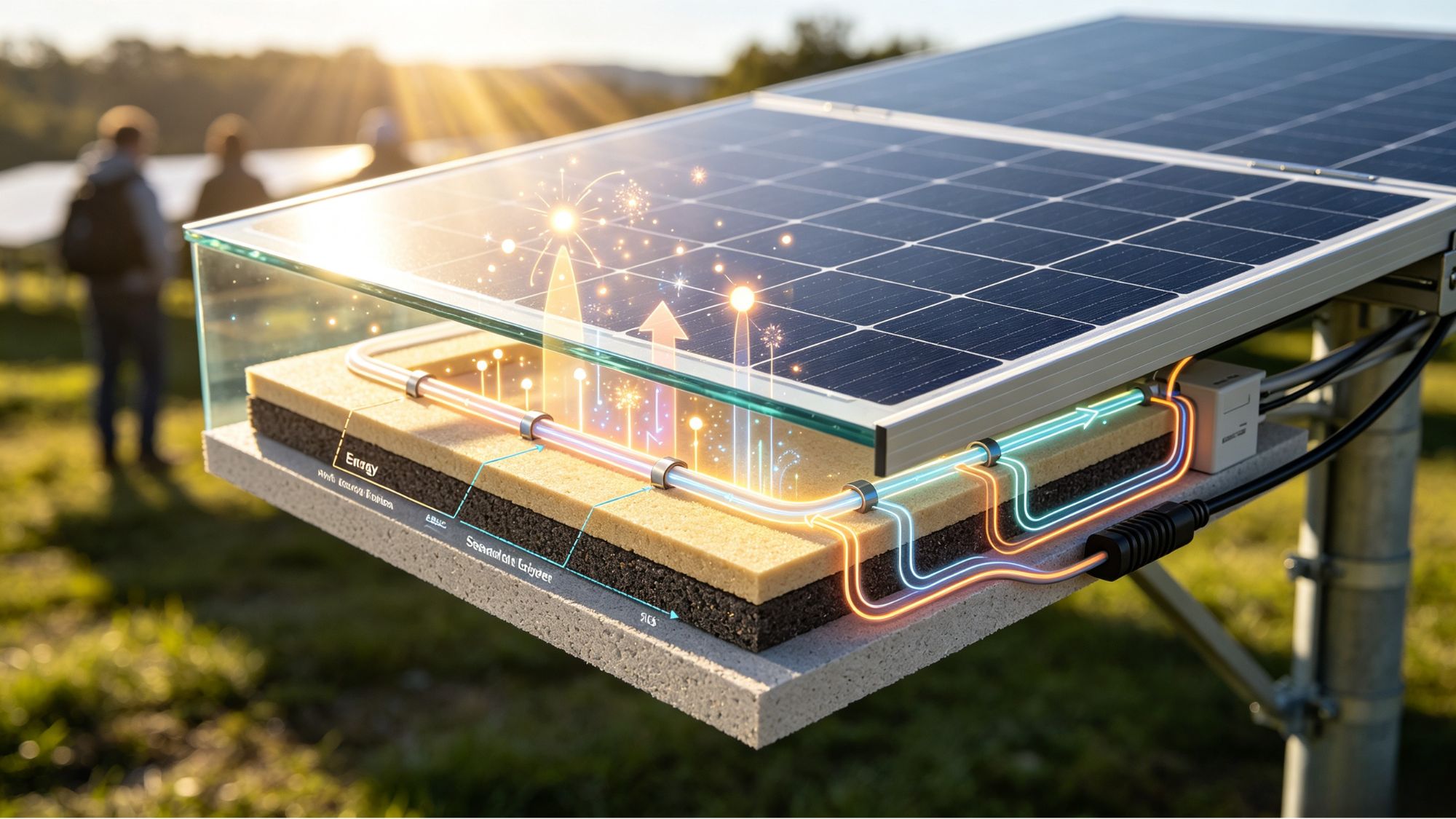
When sunlight reaches a solar panel, it can be transformed directly into electrical energy without moving mechanical parts or burning fuel. This process is made possible by photovoltaic cells, which use carefully engineered semiconductor materials to capture light energy and convert it into a flow of electricity.
Although solar panels may appear simple from the outside, the technology inside each cell involves precise control of materials and electrical forces. Silicon wafers, specially designed semiconductor layers, and internal electric fields work together to separate electrical charges and create usable current.
Understanding how photovoltaic cells work helps explain why solar energy has become one of the most important renewable power technologies.
Most commercial photovoltaic cells are built around silicon, a material with unique electrical properties that make it suitable for controlling the movement of electrons.
Unlike materials such as metals, which allow electrons to move freely, or insulators, which strongly restrict movement, silicon behaves as a semiconductor. Its ability to control electrical flow can be adjusted by adding small amounts of other elements through a process called doping.
In a solar cell, pure silicon alone is not enough to generate useful electricity. Manufacturers modify the material to create two different semiconductor layers with different electrical characteristics. These layers form the foundation of the photovoltaic process.
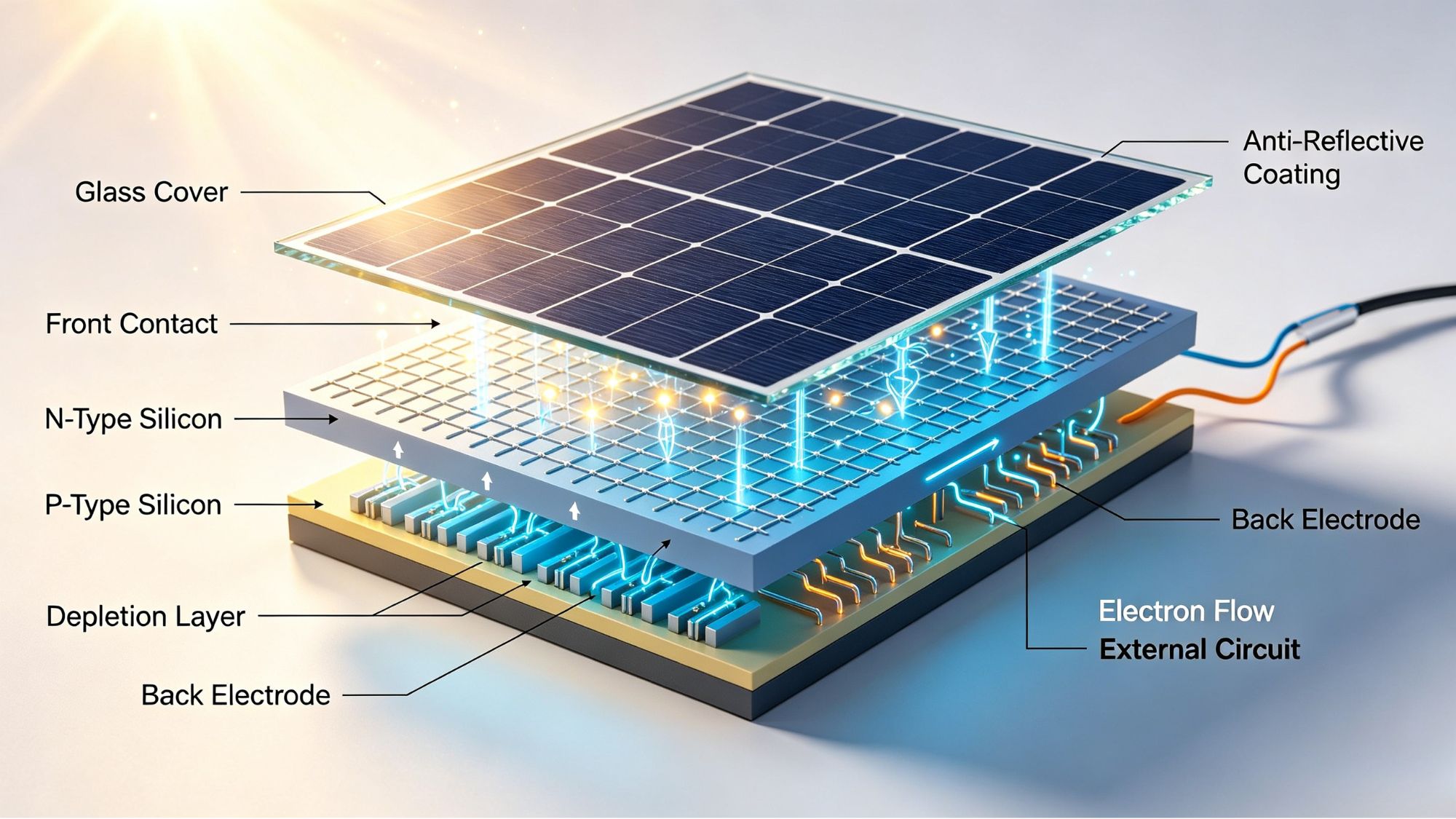
The key structure inside a solar cell is the PN junction, where two types of silicon are placed together to create an internal electric field.
The n-type layer is created by adding materials such as phosphorus to silicon.
Phosphorus atoms contain an additional electron compared with silicon atoms. When introduced into the silicon structure, these extra electrons can move more easily, making the material capable of carrying negative charge.
This layer provides a supply of mobile electrons that can participate in electrical current generation.
The p-type layer is created by adding materials such as boron.
Boron has fewer available electrons than silicon, creating small gaps in the crystal structure known as holes. These holes behave like positive charge carriers because they can accept electrons from nearby atoms.
Together, the n-type and p-type layers create the conditions needed for controlling the movement of electrical charges.
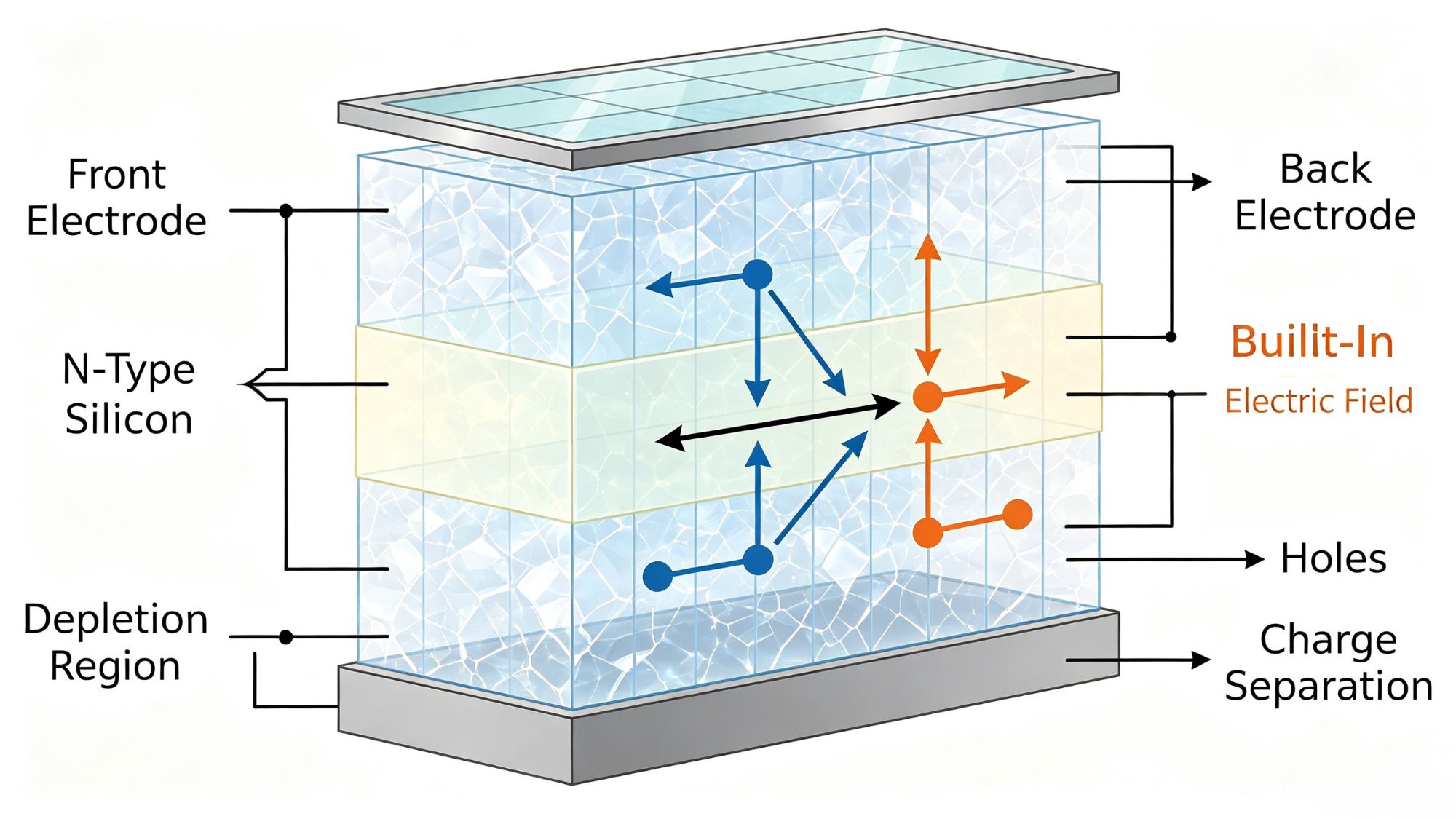
When the n-type and p-type layers are combined, electrons naturally move across the boundary between them. This movement creates a special area called the depletion region.
Inside this region, an internal electric field forms. This field acts like a built-in direction system, encouraging electrons and holes to move in specific ways rather than randomly mixing together.
This separation process is essential because electricity requires the movement of charges in a controlled direction. Without the PN junction and its electric field, newly created charges would quickly recombine and the energy from sunlight would not be converted into useful electrical power.
The actual electricity generation process begins when sunlight reaches the silicon material.
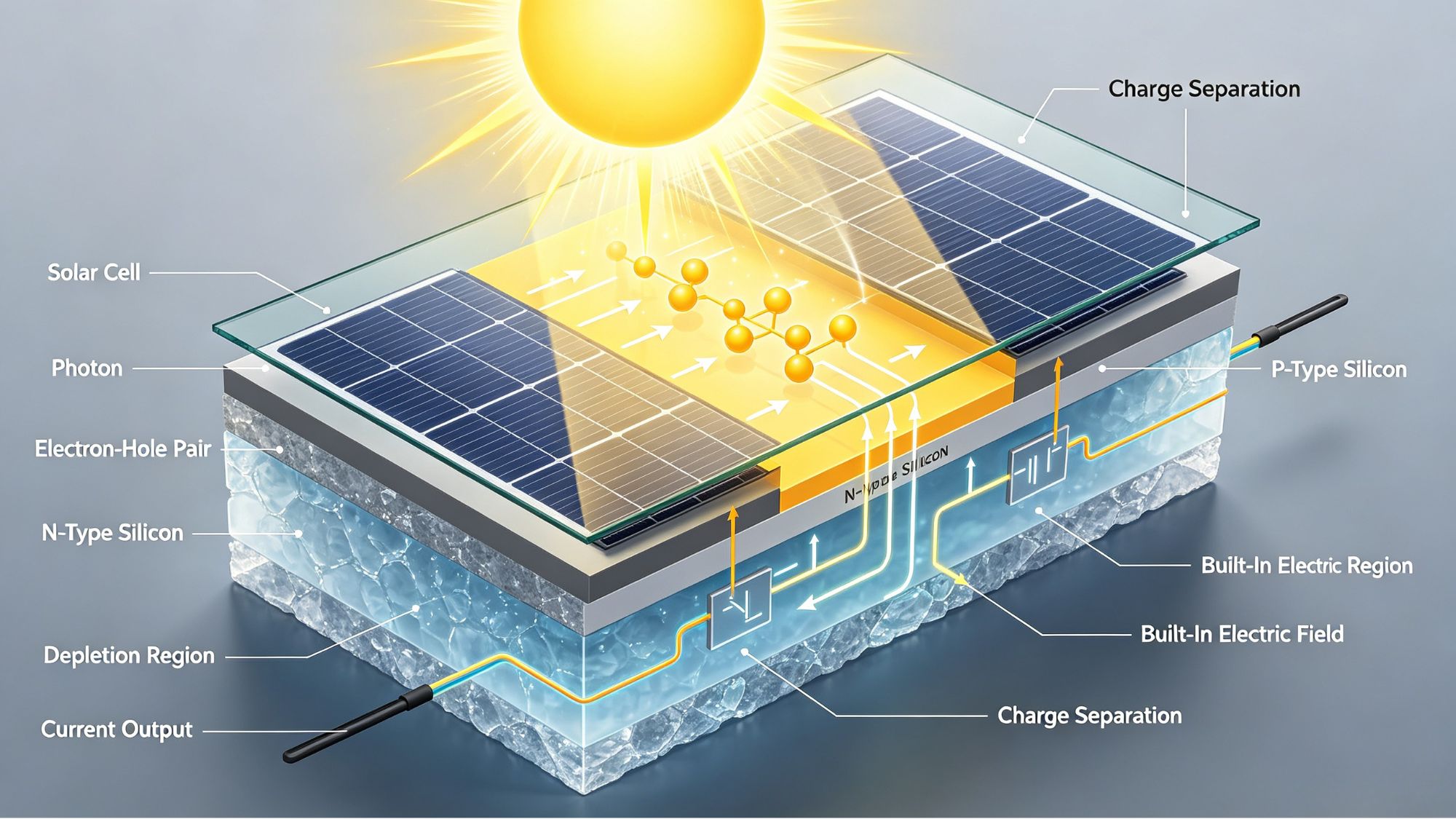
Sunlight contains tiny energy particles called photons. When photons strike the solar cell, they can transfer their energy to electrons inside the silicon structure.
If the photon energy is sufficient, an electron can break free from its normal position, creating an electron-hole pair.
The internal electric field of the PN junction then pushes electrons and holes in opposite directions:
Electrons move toward the n-type layer.
Holes move toward the p-type layer.
This movement creates a separation of electrical charges, producing the conditions needed for current flow.
Once charges are separated, the solar cell needs a way to collect and transfer that energy.
Manufacturers add conductive contacts to different parts of the cell:
The front contact collects electrons while allowing sunlight to reach the semiconductor.
The back contact collects the opposite charge carriers.
When an external circuit is connected, electrons travel through the circuit and provide electrical energy to connected devices before returning to the solar cell.
The result is direct current (DC) electricity.
Because most homes and electrical grids use alternating current (AC), additional equipment such as inverters is required to convert solar-generated electricity into a form suitable for everyday use.
Although sunlight provides the energy source, the performance of a solar cell depends on several factors.
The purity and structure of silicon affect how efficiently electrons can move through the cell. Higher-quality semiconductor materials generally reduce energy losses.
Solar output changes depending on factors such as:
Sunlight intensity
Cloud cover
Panel angle
Temperature
A solar panel does not generate the same amount of electricity at all times because environmental conditions continuously change.
A complete solar power system includes more than photovoltaic cells. Inverters, batteries, and monitoring systems help regulate electricity production and make solar energy practical for homes and businesses.
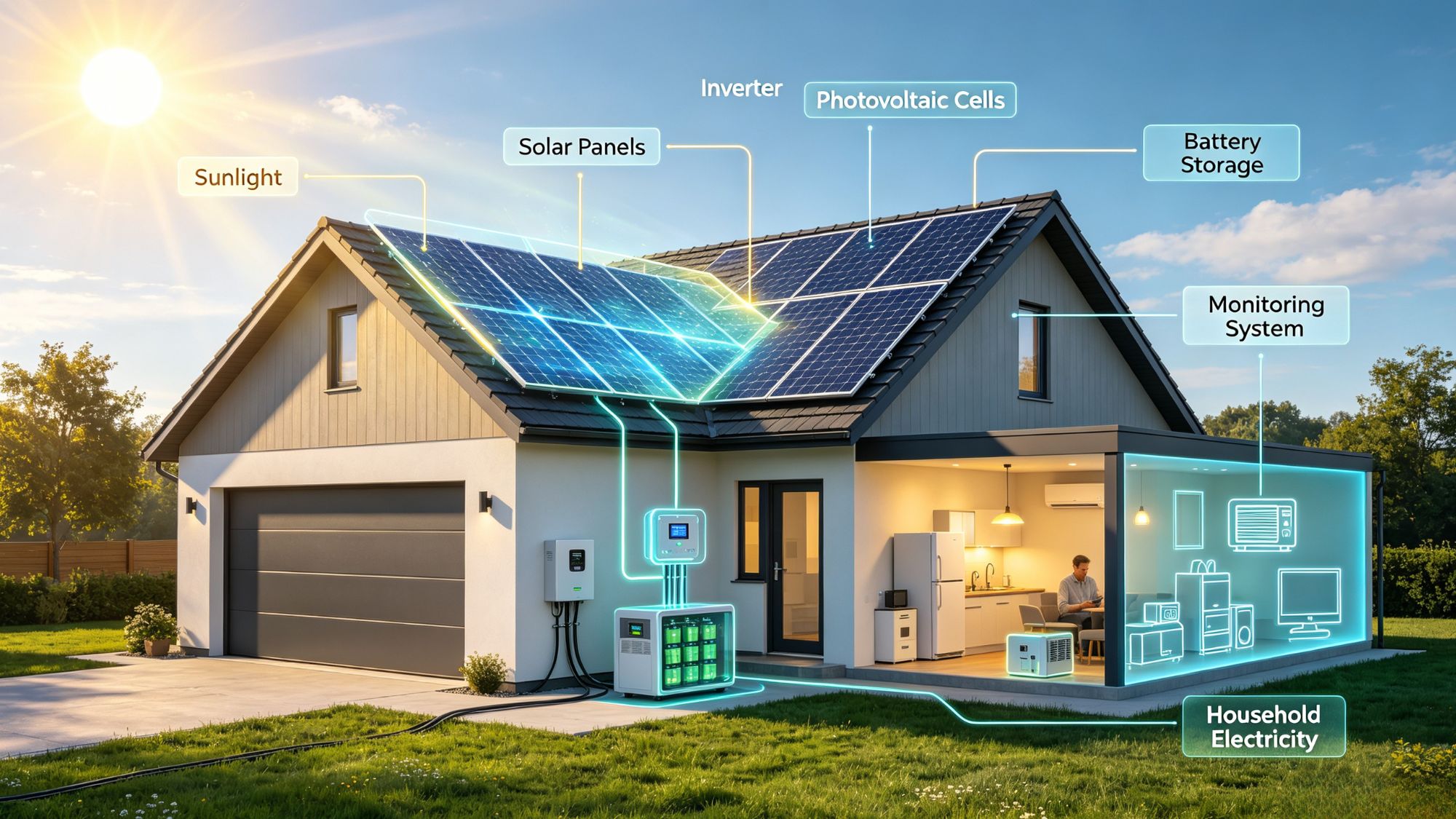
Photovoltaic cells transform sunlight into electricity through a carefully controlled process involving silicon materials, semiconductor layers, and internal electric fields.
By creating a PN junction, solar cells can separate electrons and holes generated by sunlight and direct their movement into an electrical current. Additional components then convert and manage this energy so it can power modern devices and electrical systems.
The technology behind solar panels combines principles of physics, materials science, and electrical engineering. Through this precise control of charge movement, photovoltaic systems turn an abundant natural resource into reliable renewable electricity.
